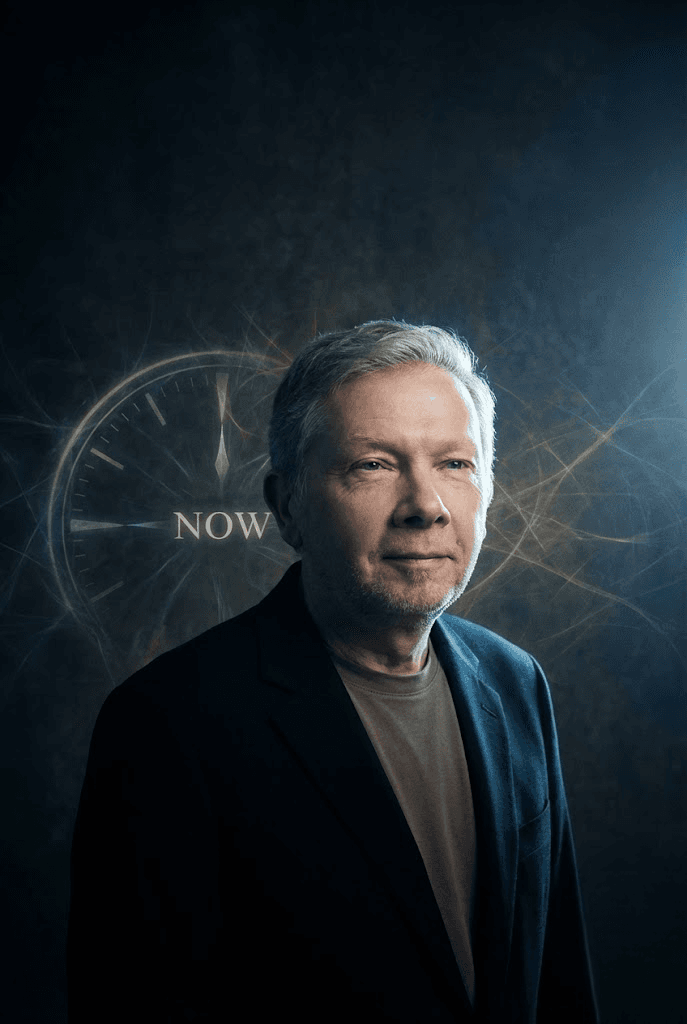
Eckhart Tolle
The foundation of human enlightenment rests on an ever-present, indestructible essence called Being. This state is not an external deity but an individual's deepest self and true nature. Accessing this state requires moving beyond the conceptual and analytical mind. When human consciousness is entirely directed outward toward the manifested world, it creates an illusion of separation that spawns fear and conflict.
Reconnecting with Being means directing attention inward to experience a felt oneness with this unmanifested source. This inward shift prevents the individual from reducing the infinite complexity of life into rigid mental labels, allowing them to experience a profound, silent awareness that underpins all physical reality.
A profound spiritual disease afflicts humanity in the form of compulsory, incessant thinking. People mistakenly believe they are their minds, allowing a mental instrument to take complete possession of their consciousness. This identification constructs the ego, a false self composed entirely of memories, cultural conditioning, and mental projections.
Because the ego is a phantom constructed from thought, it feels perpetually vulnerable and under threat. It seeks to ensure its survival by controlling behavior, demanding external validation, and creating endless mental noise that completely obscures the natural inner stillness of the human being.
Time exists in two distinct functional forms. Clock time is a practical tool used for scheduling, learning from past mistakes, and setting physical goals in the material world. Psychological time is a destructive mental trap where identity is anchored to the past and salvation is projected endlessly into the future.
The ego relies completely on psychological time to survive, constantly denying the present moment because the present threatens its conceptual existence. True freedom requires using clock time for practical necessities while aggressively severing the mental habit of dwelling on psychological time, recognizing that life only ever unfolds in the immediate now.
Emotions arise at the precise point where the mind and the physical body intersect. They are the body's direct physiological reaction to the thoughts and messages generated by the ego. The physical organism continuously receives danger signals from the mind's incessant worrying, producing a baseline frequency of fear and unease.
If a person is cut off from consciously feeling their emotions, these unresolved mental states eventually manifest as physical tension or somatic illness. When there is an apparent contradiction between a person's thoughts and their emotions, the thought represents a conscious mental fabrication, while the emotion reflects the actual truth of their underlying state of consciousness.
Unprocessed emotional pain does not simply vanish but accumulates into a semi-autonomous energy field known as the pain-body. This entity consists of past traumas and negative emotional residues lodged within the cellular structure and the unconscious mind.
The pain-body alternates between dormant and active states, awakening when triggered by situations that resonate with its specific frequency of suffering. Once active, it seeks to feed on new pain by hijacking the host's thoughts and provoking dramatic, destructive conflicts in personal relationships, ensuring its own survival through continued emotional turmoil.
Liberation from compulsory thinking requires activating a higher dimension of consciousness known as the witnessing presence. By impartially observing the voice in the head without judgment, analysis, or condemnation, a person creates space between their true self and their mechanical thoughts.
This practice starves the mind of the energy it normally gains through unconscious identification. As compulsive thoughts begin to subside, brief gaps of no-mind emerge, allowing the individual to experience pure consciousness and the underlying stillness of the present moment without losing alertness.
Human suffering operates on a sliding spectrum of unconsciousness. Ordinary unconsciousness is the pervasive, low-level background static of unease, boredom, and discontent that characterizes normal daily life. It is driven by the mind's habitual, low-grade resistance to the present moment.
Deep unconsciousness occurs when the pain-body is triggered, leading to intense emotional suffering, physical violence, or extreme despair. Shining the light of conscious attention on ordinary unconsciousness is essential to build the presence required to withstand the intense gravitational pull of deep unconsciousness when severe challenges arise.
The physical body perceived by the external senses is merely an outer shell, but it conceals a deeper, formless reality called the inner body. Directing attention away from thought and feeling the life energy of the body from within directly anchors consciousness in the present moment.
This practice withdraws energy from the egoic mind and raises the vibrational frequency of the physical organism. Sustained connection with this inner energy field strengthens the immune system and acts as a stabilizing bridge between the manifested physical world and the formless realm of pure Being.
Most romantic attachments are not rooted in true love but in the ego's addictive need for completeness and identity. Initially, a partner temporarily fills a psychological lack, creating a euphoric high that masks the ego's foundational sense of lack.
Inevitably, the partner fails to meet the ego's endless demands, causing suppressed fear and pain to resurface. The relationship then oscillates rapidly between intense affection and savage hostility. True enlightened relationships require both individuals to relinquish their egoic demands, stop judging their partner, and commit to using the relationship's friction as a catalyst for conscious presence.
Surrender is frequently misunderstood as passive resignation, lethargy, or defeat. In reality, it is the profound wisdom of yielding to the flow of life by unconditionally accepting the present moment without mental labels or emotional resistance.
Inner resistance hardens the ego, creates severe physical tension, and distorts perception. Surrender does not mean tolerating an abusive or dangerous situation indefinitely. It requires dropping all mental complaints regarding the current reality, and then taking clear, positive action out of a state of profound inner peace rather than reacting out of anger or frustration.
Extreme suffering, disaster, or severe illness possess the unique potential to crack the hardened, protective shell of the ego. When physical or emotional pain becomes absolutely intolerable, it can force a person into total surrender by breaking their attachment to psychological time.
By abandoning the mental narrative surrounding the illness and focusing entirely on the raw sensation of the present moment, suffering is stripped of its psychological burden. This intense presence acts as an alchemical fire, transmuting the base metal of human agony into the pure gold of deep serenity and enlightened consciousness.
True compassion arises only when an individual sees completely beyond the temporary veil of physical and mental forms. The ego relies on establishing differences to maintain its superiority, but deep spiritual awareness recognizes the shared mortality and impermanence of all physical bodies.
Contemplating the inevitable dissolution of physical form strips away intellectual pride and reveals the indestructible essence shared by all living things. Healing and profound connection occur naturally when one relates to others from this deep, silent space of shared Being, rendering the karmic cycle of action and reaction obsolete.
Jump into the ideas before you finish the whole summary.