
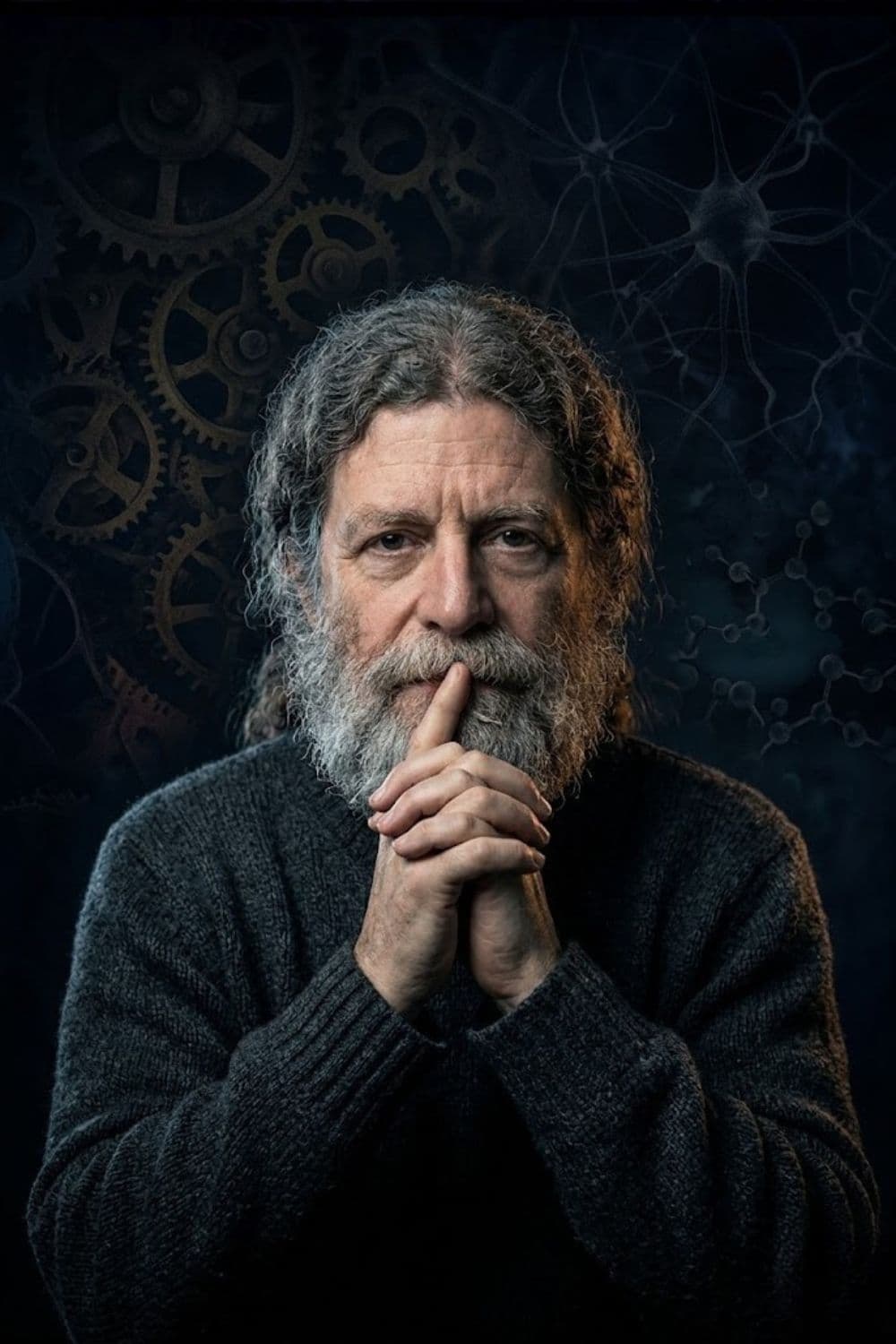
Robert M. Sapolsky
Every human action results from a sequential chain of prior causes stretching from the immediate firing of neurons back through evolutionary history. In the seconds before an action, sensory inputs and existing neural architecture dictate responses. In the preceding days and months, hormones and neuroplasticity alter brain sensitivity, while childhood experiences, fetal environment, and genetic inheritance establish fundamental cognitive frameworks. This continuous stream of biological and environmental luck leaves no conceptual space for an independent, uncaused will.
The subjective experience of intent or willpower is a biological phenomenon generated by the prefrontal cortex. The capacity to delay gratification or overcome difficult obstacles, often labeled as grit, emerges directly from uncontrollable developmental and genetic factors rather than an autonomous soul or independent self. Since the prefrontal cortex develops late into adolescence, it remains highly vulnerable to early trauma, socioeconomic status, and environmental stress. Therefore, possessing strong self-discipline is merely the outcome of favorable biological and environmental circumstances.
Biological and environmental luck does not average out over a lifetime. Instead, initial advantages or disadvantages compound iteratively. A child born into poverty frequently experiences elevated stress hormones, which impair the development of the prefrontal cortex and lead to reduced impulse control and higher risks of antisocial behavior. Society typically fails to counterbalance these early deficits, resulting in environments that further amplify the initial bad luck. Consequently, success and failure reflect an unbroken chain of uncontrollable circumstances rather than individual merit or moral failure.
If every human action is causally determined, no individual possesses the ability to act differently under identical circumstances. This biological reality renders every person fundamentally innocent, making retributive punishment logically and ethically indefensible. A legal system acknowledging this deterministic reality must abandon the concept of moral desert and the desire for vengeance. Instead, society must implement punitive measures solely to deter antisocial behavior, rehabilitate offenders, and protect the public.
Addressing dangerous individuals requires a public health approach rather than a penal one. When an individual poses a threat due to uncontrollable deficits in impulse control or a propensity for violence, society possesses a moral imperative to constrain their freedom to ensure collective safety. This constraint must function like a medical quarantine, imposing only the minimum restrictions necessary to protect the public. Simultaneously, this model demands that society address the root social determinants of criminal behavior, treating violent tendencies as symptoms of systemic environmental failures.
Asserting absolute determinism while simultaneously advocating for societal reform creates a profound logical paradox. If all human thoughts and actions are rigidly predetermined by antecedent causes, the act of attempting to persuade others to change their beliefs about justice is equally predetermined and conceptually hollow. A strictly deterministic framework implicitly exempts the author, who behaves as a rational agent capable of evaluating evidence and choosing a superior ethical stance. This contradiction reveals a critical instability in using hard determinism to demand moral progress.
Defining free will strictly as an uncaused neural event constructs a logical impossibility that ignores the principles of theoretical biology. Complex systems exhibit emergent properties where higher level organizational structures constrain and channel the behavior of their lower level components. This constraint causation allows organisms to actively regulate their internal states and interact dynamically with their environments. By treating causality solely as a linear, bottom-up chain of efficient causes, strict biological determinism fails to account for the causal efficacy of biological organization and autonomous self-regulation.
Promoting an absolute lack of free will directly contradicts the psychological benefits of a growth mindset. Experimental evidence demonstrates that teaching individuals that their cognitive abilities and behavioral traits are malleable significantly improves academic and personal outcomes. Convincing people that their actions and attributes are permanently fixed by uncontrollable prior causes fosters a debilitating fixed mindset. Stripping away the belief in personal agency risks eroding motivation, learning capacity, and the practical ability to enact positive behavioral changes.
Dispensing with notions of personal culpability may not yield the compassionate society that determinists envision. Viewing individuals primarily as mechanistic biological systems driven by involuntary processes often increases social distance and stigma. When people perceive others as lacking moral competence and the ability to control their actions, they frequently favor longer, more authoritarian periods of quarantine or institutionalization to ensure safety. Furthermore, the abstract threat of social ostracism and moral shame serves as a powerful, necessary input that heavily disincentivizes harmful behavior in complex human communities.