
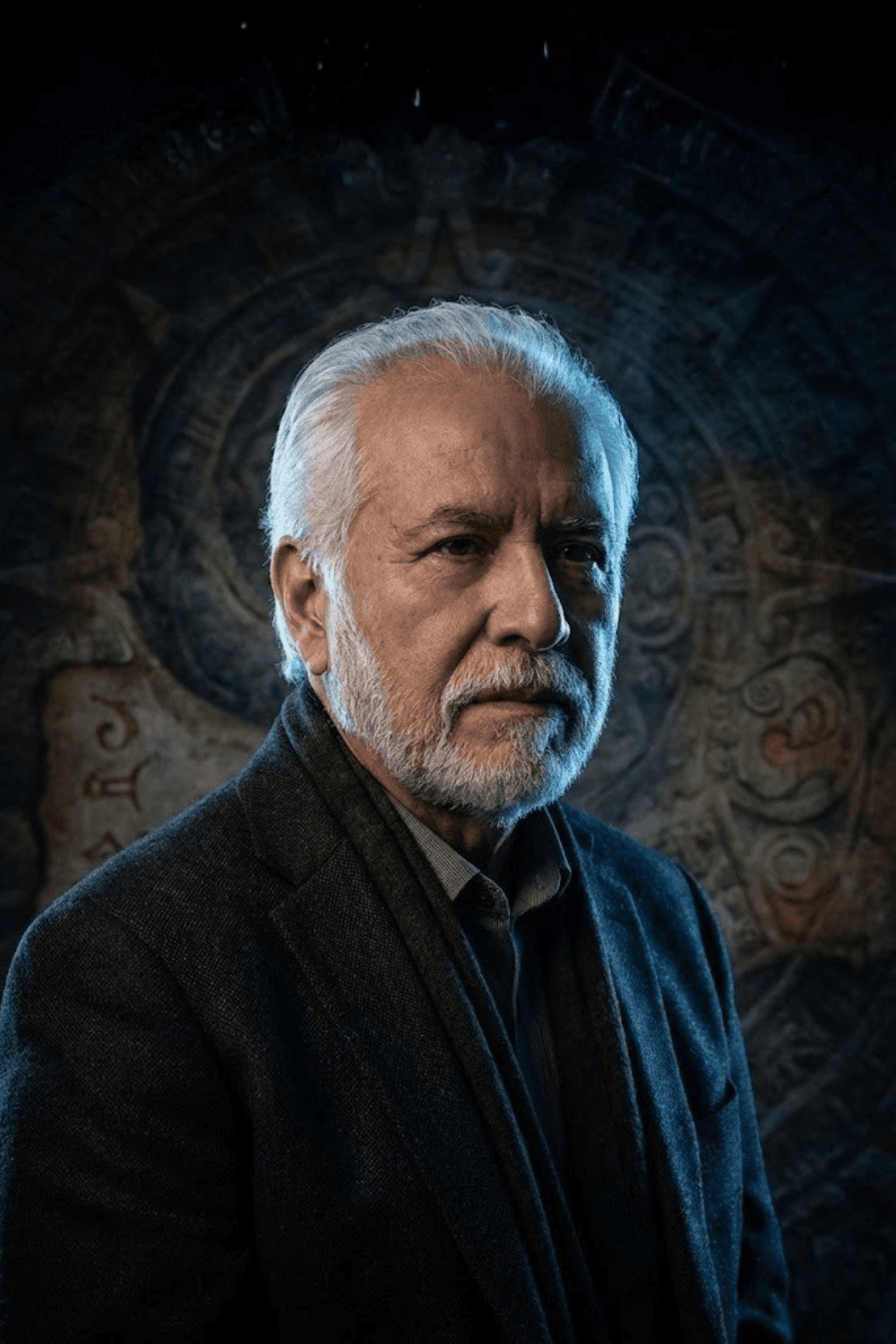
Don Miguel Ruiz
Carlos Castaneda catalyzed the transformation of the word Toltec from a specific historical Mesoamerican culture into a globalized postmodern spiritual phenomenon. Leveraging his anthropological training, he actively repurposed academic theories regarding ancient Mesoamerica. He systematically stripped concepts of their historical grounding, molding them to serve the psychological needs of contemporary seekers rather than adhering to archaeological records.
In ancient Mesoamerica, terms like Nahual and Tonal referred to companion spirits or animal alter egos utilized by elites and shamans. This traditional framework was completely dismantled and redefined in the twentieth century. The Tonal became the structured, rational, and knowable world. Conversely, the Nagual was positioned as the terrifying, incomprehensible void that forever escapes human rationalization. Over time, this vast cosmological duality narrowed, and the term Nagual transformed into a hierarchical title designating a chief sorcerer or leader within a specific spiritual lineage.
Twentieth-century scholarship heavily promoted the theory of a massive Toltec migration, suggesting that an advanced civilization collapsed in Central Mexico and subsequently spread its wisdom across wider Mesoamerica. This exact narrative architecture built the foundation of modern Toltec spirituality. The ancient Toltecs are presented not as a localized ethnic group, but as an elite, transnational lineage of powerful sorcerers. A secretive faction of new seers supposedly survived the historical collapse of this empire, preserving a transcultural tradition of spiritual mastery designed to defy human limits.
Human beings live in a collective illusion called the dream of the planet, which is constructed from inherited societal rules, cultural backgrounds, and familial expectations. This process of domestication forces individuals to internalize a rigid set of laws, creating a severe internal judge and a perpetual victim. Because these beliefs are absorbed unconsciously, they trap people in a cycle of self-judgment and fear. To achieve personal freedom, an individual must actively break these unconscious agreements and replace them with intentional choices.
The foundational principle of this modern framework demands that individuals speak with absolute integrity. Language functions as an active, creative force capable of manifesting reality, requiring practitioners to abstain from self-deprecation and gossip. However, strict adherence to this psychological framework generates problematic extremes. Asserting that words and beliefs single-handedly dictate material reality implies that individuals subconsciously summon their own physical illnesses or systemic misfortunes through negative thinking.
Human suffering heavily stems from personal importance, the flawed assumption that the actions of others are directed at us. Recognizing that external behaviors merely reflect other people's subjective realities allows a person to build immense emotional resilience. By refusing to absorb external emotional poison, an individual starves their internal need for validation. Yet, oversimplifying boundaries by refusing to take anything personally invalidates the real damage inflicted by systemic discrimination, toxic environments, and interpersonal abuse.
Unspoken assumptions fuel cycles of misunderstanding and relational destruction. Because assumptions rely on incomplete information, they force the mind to invent further fabrications to justify the initial false belief. Eradicating this habit requires the courage to ask direct questions and articulate desires clearly. This direct communication must parallel a commitment to always execute one's best effort in any given moment. Recognizing that personal capacity fluctuates daily prevents destructive self-judgment and ensures that actions are driven by genuine engagement rather than the expectation of external rewards.