
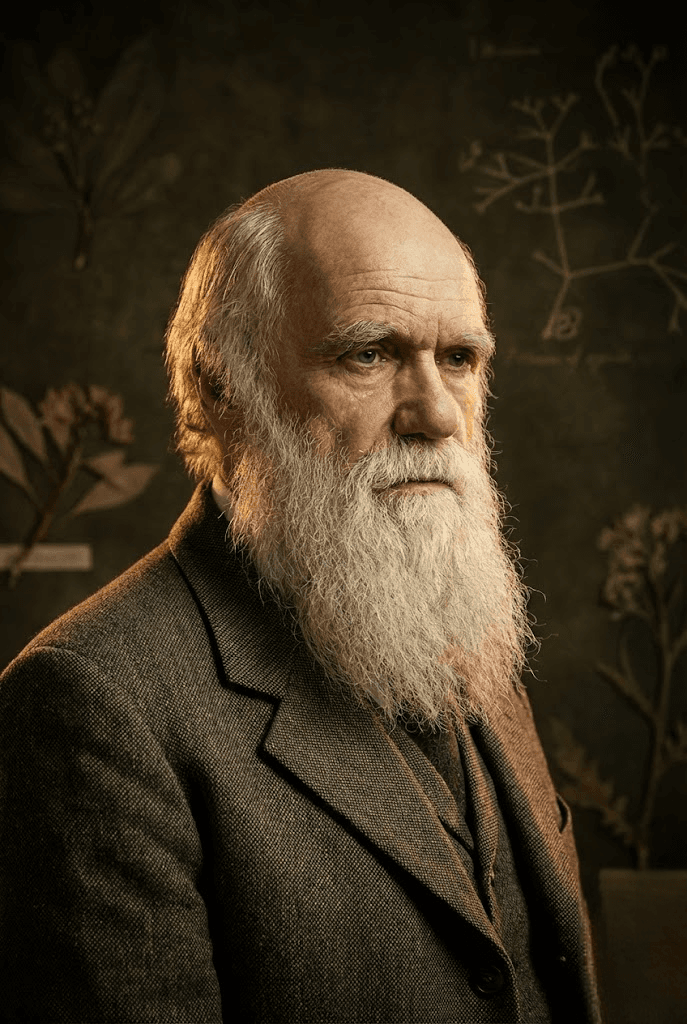
Charles Darwin
Organisms possess an inherent capacity for exponential population growth, yet environmental resources remain strictly limited. This biological reality guarantees a continuous struggle for existence among individuals within any given environment. Because no two individuals are exactly alike, those possessing spontaneous physical or behavioral variations best suited to their local conditions possess a distinct survival advantage. Consequently, these highly adapted individuals are far more likely to reproduce and pass their favorable traits to the subsequent generation.
Over vast spans of time, this unequal ability to survive and reproduce drives the accumulation of advantageous characteristics throughout a population. Nature systematically filters the genetic pool, seamlessly adapting species to their specific ecological niches. This differential success in reproduction forms the mechanical core of evolutionary change, driving the eventual divergence of single ancestral lineages into entirely distinct species.
To introduce a highly controversial mechanism for biological transmutation, the argument required a conceptual foundation built upon undeniable, observable facts. The well-documented concept of artificial selection provided the perfect intellectual bridge. By detailing the familiar practices of pigeon fanciers and livestock breeders, it became evident that deliberate selection could produce profound morphological changes over relatively few generations. This established human-directed breeding as an observable cause capable of generating massive biological variation.
The argument then projected this domestic reality directly onto the natural world. If human intervention could produce highly distinct breeds in a few centuries, the infinitely harsher and more persistent pressures of the natural environment could surely sculpt entirely new species over millions of years. This analogical reasoning satisfied the rigorous Victorian scientific standards of the era, which demanded that any proposed theoretical mechanism must be demonstrated as an active, competent force in the observable world before being applied to unobservable historical processes.
Despite the rapid scientific acceptance of descent with modification, the specific mechanism of natural selection faced severe headwinds during the late nineteenth century. Physicists calculating the cooling rate of the Earth estimated the planet's age at a mere hundred million years. This timeframe was vastly insufficient to accommodate the incredibly slow, gradual accumulation of minute variations required by natural selection. To combat this mathematical barrier, evolutionary theorists were forced to incorporate alternative mechanisms, including the rapid inheritance of acquired characteristics, to artificially accelerate the proposed rate of biological change.
Simultaneously, the prevailing biological assumption of blending inheritance threatened to mathematically eliminate all advantageous variations. If offspring simply averaged the physical traits of their parents, any rare, beneficial mutation would be systematically diluted and entirely absorbed by the larger population within a handful of generations. Lacking a coherent model of genetics, the scientific community began to largely abandon natural selection in favor of alternative developmental models that shielded new variations from this blending effect.
As confidence in natural selection waned, alternative theories of evolutionary development flourished among leading biologists. Many paleontologists adopted orthogenesis, arguing that distinct internal forces drove species along predetermined, linear evolutionary paths regardless of environmental utility. This perspective gained massive traction because it seamlessly explained the sequential, directional trends observed in newly excavated fossil records, such as the gradual development of the ancient horse. Other scientists turned to saltationism, proposing that entirely new species emerged through sudden, massive mutations rather than through the sluggish accumulation of microscopic changes.
The most prominent alternative was Neo-Lamarckism, which posited that physical traits acquired by an organism during its lifetime could be directly transmitted to its offspring. This theory provided a highly efficient mechanism for rapid adaptation, seemingly bypassing both the problem of genetic swamping through blended inheritance and the restrictive timeframe imposed by contemporary physics. These competing paradigms dominated biological thought until the foundational mechanics of cellular heredity were finally uncovered.
The eventual rediscovery of particulate inheritance revolutionized evolutionary biology and rescued natural selection from scientific obscurity. Mendelian genetics proved that biological traits are passed down as discrete units rather than as blended averages. Because genetic information remains completely intact across generations, advantageous mutations can easily spread through a population without being diluted out of existence. This revelation permanently solved the primary mathematical flaw that had historically haunted early evolutionary theory.
This integration of genetic science with the mechanics of natural selection formed the modern evolutionary synthesis, widely known as Neo-Darwinism. This updated framework firmly identified genetic mutation and chromosomal recombination as the absolute sources of biological variation. By stripping away outdated concepts of acquired characteristics and internal progressive forces, the modern synthesis established that evolution is driven exclusively by environmental pressures acting upon random, inherited genetic variations.
The application of evolutionary mechanics to human beings generated immediate and profound societal friction. While the anatomical similarities between humans and other primates provided compelling evidence for a shared physical ancestry, the origins of human morality and advanced cognition proved significantly more contentious. Traditional philosophical frameworks insisted that mental and moral faculties were uniquely endowed spiritual attributes, fundamentally separating humanity from the rest of the animal kingdom.
Evolutionary theorists argued instead that even the most exalted human traits, including altruism and religious devotion, evolved incrementally from the basic social instincts of lower primates. They posited that cooperative behaviors and heightened intelligence conferred massive survival advantages to early hominids, ensuring the preservation and progressive enhancement of these traits through natural selection. This strictly materialist explanation for human consciousness fractured the scientific community, leading even prominent co-founders of the evolutionary theory to insist that an external intelligence must have intervened to produce the modern human mind.