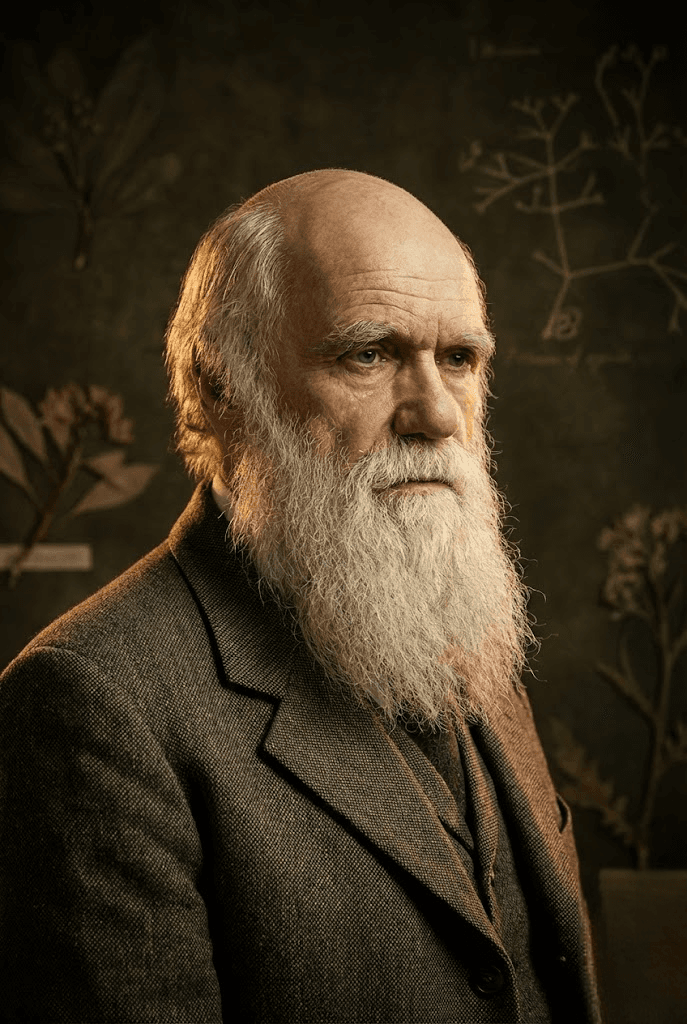
Charles Darwin
Before Charles Darwin formulated his biological theories, his intellectual foundation was built upon competing geological paradigms. The dominant view of catastrophism posited that Earth's history was shaped by rapid, violent events and successive divine creations. However, Darwin ultimately embraced uniformitarianism, which argued that the slow, observable geological processes acting in the present also shaped the deep past. This shift provided the vast canvas of continuous, gradual change necessary for his eventual theory of biological evolution. By adopting the perspective that immense, imperceptible physical changes yield massive geological results, Darwin primed himself to apply the exact same logic to the organic world.
While the public often associates the proof of evolution with the fossil record, the earliest and strongest evidence actually stemmed from historical biogeography. During global exploration, it became evident that extinct fossil mammals in South America closely resembled the living species currently inhabiting the same continent. Furthermore, closely related but distinct species replaced one another across different latitudes along the mainland. When combined with the observation that species on newly formed volcanic islands bore a striking resemblance to nearby continental species, the concept of special creation fractured. These localized patterns of faunal succession and geographical distribution demonstrated that species migrated and adapted over time, providing the fundamental proof that evolution had occurred long before the exact mechanism was fully understood.
To make the radical concept of undirected evolution palatable to a skeptical audience, Darwin employed a masterful rhetorical strategy that bridged the familiar with the revolutionary. The overarching argument began not in the wild, but in the barnyard, detailing the extensive variations produced by pigeon fanciers and agricultural breeders. By establishing that humans could mold species by selectively breeding for desired traits, the reader's agreement on the plasticity of physical forms was secured. A crucial intellectual pivot followed, arguing that nature itself possesses a similar, though far more powerful and ancient, capacity to select advantageous traits. This analogy allowed the subversion of the traditional view of a conscious divine designer, replacing it with an unconscious, self-acting mechanism that could accomplish far more than human artifice.
At the core of the evolutionary mechanism is a stark demographic reality borrowed from contemporary population theory. Organisms possess the reproductive capacity to multiply exponentially, yet natural populations remain relatively stable due to the severe limitations of food, space, and environmental hazards. This creates an unceasing, brutal struggle for existence in which only a fraction of offspring can survive to reproduce. The natural world is painted as a landscape brimming with unseen conflict, where a superabundance of life constantly battles against scarcity and predation. Within this intense crucible, any individual born with a slight, inheritable advantage over its peers is more likely to survive, reproduce, and pass that favorable trait to the next generation.
Natural selection does not merely adapt a single lineage in a straight line, because it actively drives the multiplication of species through a process called the divergence of character. As populations compete for limited resources, those individuals that exploit new or marginal ecological niches face less direct competition. Over countless generations, the continuous preservation of variations suited to different environments causes descendent populations to diverge morphologically from their common ancestor and from one another. This branching process, akin to a great tree continually producing new twigs while older branches perish, explains the hierarchical classification of life. It demonstrates how a single ancestral species can radiate into a multitude of distinct forms, each uniquely adapted to its specific way of life.
A major structural component of the overarching argument is a preemptive defense against its greatest vulnerability, which is the glaring absence of finely graduated transitional links in the fossil record. Rather than denying this gap, considerable effort is dedicated to explaining the extreme imperfection of geological preservation. The fossilization of remains is framed as an exceptionally rare event requiring specific sedimentary conditions that are frequently erased by continuous erosion and tectonic shifts. Furthermore, the abrupt appearance of major biological groups is explained as an illusion caused by the sparse, sporadic nature of the rock strata. By characterizing the earth's crust as a badly damaged history book with missing pages and lost chapters, the text successfully argued that the lack of transitional fossils was a failure of the geological archive rather than a failure of the biological theory.
The internal logic of slow, gradual evolution demanded almost limitless expanses of geological time, a requirement that created severe tension with the physical sciences of the era. Initial arguments relied on crude geological calculations, such as the slow erosion of coastal cliffs, to argue for a planet hundreds of millions of years old. However, physicists analyzing the cooling rate of the earth and the sun calculated a much younger planet, arguing that the environment had not been habitable long enough to support a creeping pace of biological change. This temporal constraint remained one of the most formidable external challenges to the evolutionary framework, forcing continuous adjustments to the argument while steadfastly maintaining that the true age of the earth was vastly greater than what contemporary mathematics could prove.
Beyond geographic distribution, structural proof of common descent was sought within the bodies of organisms themselves. Deep anatomical similarities across wildly different species highlight that the bone structure in a human hand, a bat wing, and a whale flipper follow the exact same underlying pattern despite serving entirely different functions. Additionally, the embryos of distinct classes of animals are often indistinguishable in their early stages, only developing their specialized traits later in gestation. This unity of type, along with the presence of vestigial organs that no longer serve a functional purpose, makes no logical sense under the paradigm of independent creation. Instead, these anatomical echoes provide a clear biological blueprint revealing that diverse species are heavily modified descendants of a shared ancient progenitor.
To secure a hearing among scientists and laymen deeply entrenched in religious orthodoxy, Darwin masterfully appropriated the language of natural theology to serve a thoroughly naturalistic end. Natural selection is frequently described with personified, reverent language, depicting nature as a wise, scrutinizing force that perfectly adapts organisms to their environments. By framing a mechanistic theory in the familiar cadence of divine providence, the lines between intelligent design and undirected biological processes were effectively blurred. This rhetorical ambivalence allowed readers to tentatively accept the mechanics of evolution while maintaining a sense of wonder and order, subtly shifting the cultural consensus toward a completely material universe without requiring an immediate, traumatic break from religious sentiment.
Despite careful logic and rhetorical brilliance, the evolutionary framework encountered fierce resistance from leading geologists and paleontologists, a group characterized as the immutabilists. These experts read the fossil record literally, viewing the sudden appearance and disappearance of species not as an artifact of poor preservation, but as hard evidence of catastrophic extinctions followed by new, independent acts of creation. Because biology lacked a clear mechanism for genetic inheritance, geology and paleontology remained the ultimate arbiters of deep history, and their practitioners were largely unwilling to abandon the stability of fixed species. This prolonged intellectual battle highlights the profound difficulty of displacing an entrenched scientific paradigm, demonstrating that the eventual triumph of the theory relied as much on a generational shift within the scientific community as it did on the overwhelming accumulation of biological facts.
Jump into the ideas before you finish the whole summary.