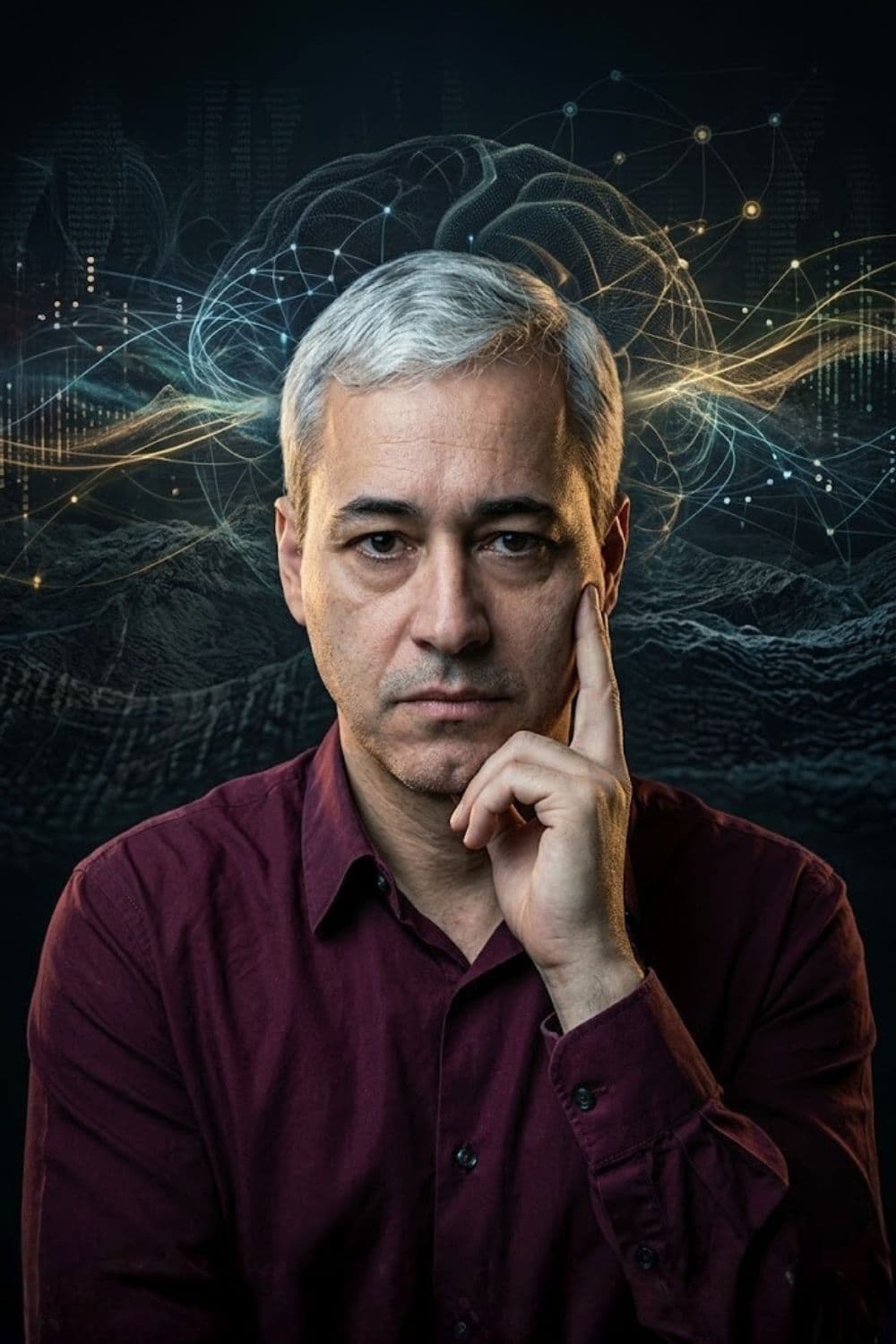
Pedro Domingos
The central hypothesis of the field posits that all knowledge, whether past, present, or future, can be derived entirely from data by a single universal learning algorithm. Rather than relying on separate mechanisms for distinct types of problems, this master algorithm would act as a general purpose learner. It would possess the capability to simulate any other algorithm simply by observing its input and output behavior. Discovering this unifier would allow any application to utilize a common underlying structure to solve infinitely diverse problems, providing a singular computational key to understanding complex phenomena.
Traditional algorithms operate as rigid sequences of precise instructions, taking data as an input to produce a specific output. Machine learning reverses this paradigm by taking both the input data and the desired output to generate the algorithm itself. The human programmer acts less like a dictator of logic and more like a farmer, providing the seeds of the learning mechanism and the soil of the data, allowing the machine to grow the specific rules needed to solve a problem. This abstraction allows machines to tackle tasks that human programmers cannot precisely define, such as deciphering handwriting or recognizing speech patterns.
When an algorithm becomes too powerful, it begins to hallucinate patterns that do not exist, a phenomenon known as overfitting. If a computer possesses enough processing power, it will inevitably find arbitrary correlations within any large dataset, constructing complex models that perfectly explain the training data but fail completely when applied to new information. To prevent these algorithmic hallucinations, researchers must intentionally restrict the flexibility of their models. They hold out a portion of the data during the learning phase, using this isolated set exclusively to verify that the discovered patterns represent universal truths rather than isolated flukes.
Symbolists approach machine learning through the lens of philosophy and formal logic, treating learning as the inverse of deduction. Because they view raw sensory data as inherently unreliable, they rely on rigid rules and deductive reasoning to build intelligence. Their primary tool is the decision tree, which organizes data by asking a cascading series of questions to narrow down possibilities. By restricting the number of questions a tree can ask, Symbolists prevent overfitting and isolate the most broadly applicable rules within massive datasets, excelling in environments that require clear, interpretable categorizations.
Inspired by physics and neuroscience, Connectionists build artificial neural networks that mirror the biological architecture of the human brain. Instead of following sequential logic, these networks process multiple inputs simultaneously through hidden layers of interconnected artificial neurons. By continuously analyzing the strength and volume of signals passing between these nodes, the system dynamically adjusts its internal connections to minimize errors. This approach excels at interpreting raw perceptual data like images or audio, but it often operates as an opaque black box where the internal logic of a decision remains entirely hidden from human observers.
Bayesians reject the idea of absolute certainty, viewing machine learning primarily as an exercise in statistical probability. Rather than determining a single rigid outcome, Bayesian algorithms keep multiple hypotheses open simultaneously, adjusting the mathematical belief in each model as new evidence emerges from the data. To avoid overfitting, this approach intentionally restricts assumptions, often focusing strictly on isolated cause and effect relationships while ignoring secondary interactions. By strictly defining what events influence each other, Bayesian systems elegantly handle noisy, uncertain, or incomplete data.
Drawing entirely from biology, Evolutionaries treat algorithms not as fixed equations but as living structures that must adapt to survive. They utilize genetic algorithms to simulate the process of natural selection within a computer environment. An initial population of algorithms is generated and tested against a specific environment or task, with the most successful versions allowed to mutate and combine. Over countless iterations of trial and error, the system continually evolves highly adapted solutions, making this methodology particularly effective for dynamic, unstructured challenges like autonomous navigation and complex gameplay.
Analogizers root their philosophy in psychology, operating on the premise that the most effective way to understand a new situation is to recognize its similarities to known situations. They rely on support vector machines and nearest neighbor algorithms to classify new inputs based on their physical or conceptual proximity to established clusters of data. This methodology is the driving engine behind modern recommendation systems. By grouping individual users or items into distinct classes based on shared characteristics, Analogizers can accurately predict future preferences by extrapolating the known outcomes of similar entities.
While many algorithms require neatly labeled examples to function, unsupervised learning algorithms are designed to dive directly into raw, unorganized data. These systems excel at reducing the dimensionality of a problem, stripping away millions of irrelevant data points to isolate a few essential, defining variables. Through targeted clustering techniques, unsupervised algorithms can spontaneously discover distinct categories and meaningful architectural structures hidden within chaotic environments. This allows systems to isolate a single voice in a crowded room or categorize objects without ever being explicitly instructed on what those targets represent.
Because no single algorithm is flawless, the ultimate goal of machine learning is to unite the specialized strengths of the five distinct tribes into a single unified architecture. Each tribe possesses a critical missing piece. Symbolists offer formal logic, Connectionists provide perceptual structure, Bayesians manage uncertainty, Evolutionaries supply adaptability, and Analogizers recognize broad similarities. Current unifying attempts merge these elements by using logic networks for representation, probabilistic inference for evaluation, and a hybrid of genetic search and continuous error correction for optimization. This synthetic approach attempts to build an algorithm capable of solving fundamentally unrelated problems across every intellectual domain.
As algorithms grow more sophisticated, the vast trail of data generated by modern life allows for the creation of highly accurate digital models of individuals. A master algorithm fed with a lifetime of personal records, behaviors, and choices could eventually function as a continuous digital proxy. This proxy could seamlessly interact with other digital models, negotiating job offers, filtering daily information, and making complex logistical decisions on an individual's behalf. To protect this immense strategic asset, societies will likely require data banks and data unions, allowing citizens to securely store their digital identities and collectively negotiate the exact terms of how their personal models interact with the broader world.
Jump into the ideas before you finish the whole summary.