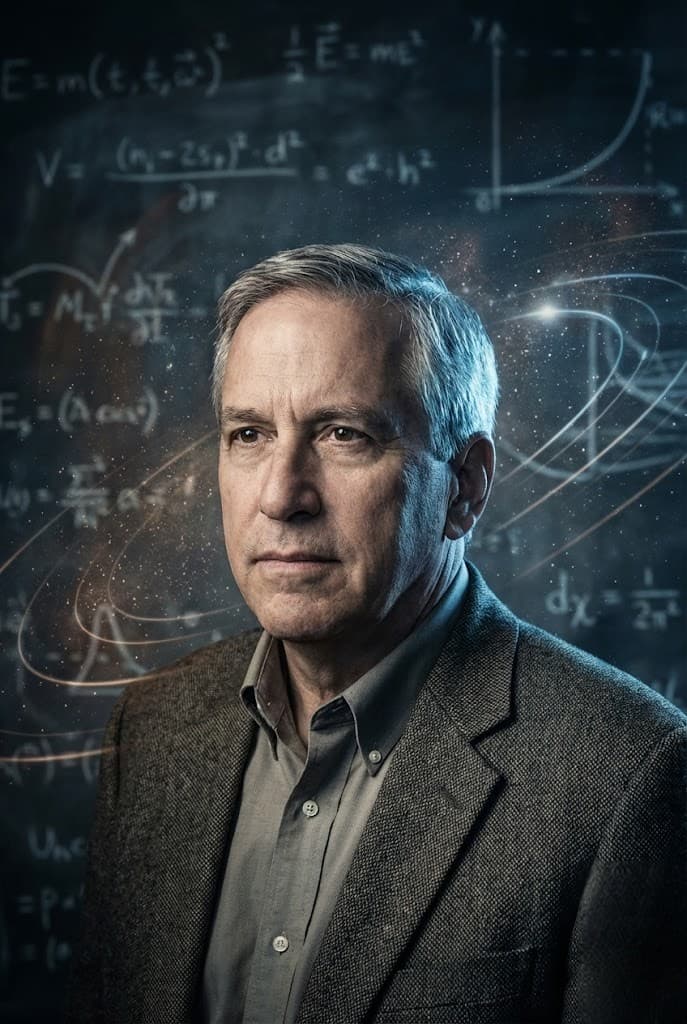
Walter Isaacson
Albert Einstein possessed a fundamental disdain for arbitrary authority and dogmatic thinking. This rebellious nature was not merely a personality quirk but the very engine of his scientific genius. As a student he rejected the rigid regimentation of his schooling, preferring to cultivate a skeptical independence. This lifelong resistance to blindly following accepted wisdom allowed him to question the foundational assumptions of classical physics that others took for granted.
Rather than beginning with abstract mathematical equations, Einstein derived his most profound insights through vivid visual imagination. He utilized thought experiments to simulate complex physical phenomena in his mind. By visualizing a person riding alongside a beam of light or an observer falling freely inside a closed elevator, he bypassed the limitations of classical mechanics. Only after he conceptually solved these visual puzzles did he seek out the mathematical frameworks required to prove them.
During his miraculous year of discovery, Einstein shattered the Newtonian concept of a universe governed by a single, absolute ticking clock. His special theory of relativity posited that the speed of light is constant, meaning that time and space must be relative to the observer. If two individuals are moving at different speeds, they will experience the passage of time differently, rendering the concept of absolute simultaneity an illusion. This realization fundamentally altered the human understanding of reality.
Einstein expanded his theories to explain gravity not as an instantaneous force pulling objects together, but as a distortion in the fabric of space and time. Through his principle of equivalence, he realized that the local effects of gravity and acceleration are indistinguishable. This led to the monumental claim that massive objects dictate the curvature of spacetime, and this curvature dictates how objects move. It was a complete architectural reimagining of the cosmos, ultimately proven when astronomers observed the sun's gravity bending the light of distant stars.
Despite laying the groundwork for quantum mechanics by proving that light travels in discrete packets, Einstein fiercely rejected the theory's later evolution. When quantum theorists determined that subatomic particles operate on probability and chance rather than strict cause and effect, Einstein rebelled. He held a deeply rooted philosophical belief that the universe operates according to strict deterministic laws, famously asserting that the creator does not play dice.
Einstein's battle against quantum mechanics revealed a profound structural irony in his life arc. The young radical who upended the physics establishment by questioning absolute truths eventually transformed into the stubborn conservative defending the old order of strict causality. He recognized this paradox himself, noting that fate had punished his lifelong contempt for authority by turning him into an unquestioned authority.
Einstein rejected orthodox religion and the concept of a personal deity, yet he maintained a profound spiritual reverence for the universe. His religious feeling was defined by a rapturous awe at the harmony, beauty, and comprehensibility of natural laws. This reverence was tied to a strict belief in determinism, where every event, from the movement of stars to human decisions, is governed by immutable forces. He viewed science and religion as complementary lenses for experiencing the profound mystery of existence.
A stark dichotomy defined Einstein's relationships. He possessed a deep, humanitarian love for mankind as a whole, yet he often displayed chilling emotional detachment toward those closest to him. His marriages were fraught with tension, infidelity, and eventual emotional distancing, culminating in a rigid contract of domestic demands he imposed on his first wife. He found his ultimate refuge not in human intimacy but in the solitary sanctuary of scientific contemplation.
Einstein's political philosophy was defined by an ardent, yet flexible, pacifism. Appalled by the nationalistic bloodlust of the First World War, he actively campaigned against militarism. However, the rise of totalitarianism forced him to adapt his stance, leading him to urge the development of an atomic program to counter the Nazi threat. Recognizing the existential danger of the weapons he helped make possible, he spent his later years fiercely advocating for global nuclear disarmament and the establishment of a unified world government to eradicate war.
In his later decades, Einstein isolated himself from the mainstream physics community to pursue a unified field theory. He sought a single, elegant mathematical framework that would seamlessly connect gravity and electromagnetism. While quantum mechanics surged forward as the dominant focus of his peers, Einstein worked largely alone, stubbornly trying to read the ultimate mind of the creator. Though this final intellectual journey ended without success, it underscored his unwavering commitment to uncovering the fundamental architecture of reality.
Jump into the ideas before you finish the whole summary.