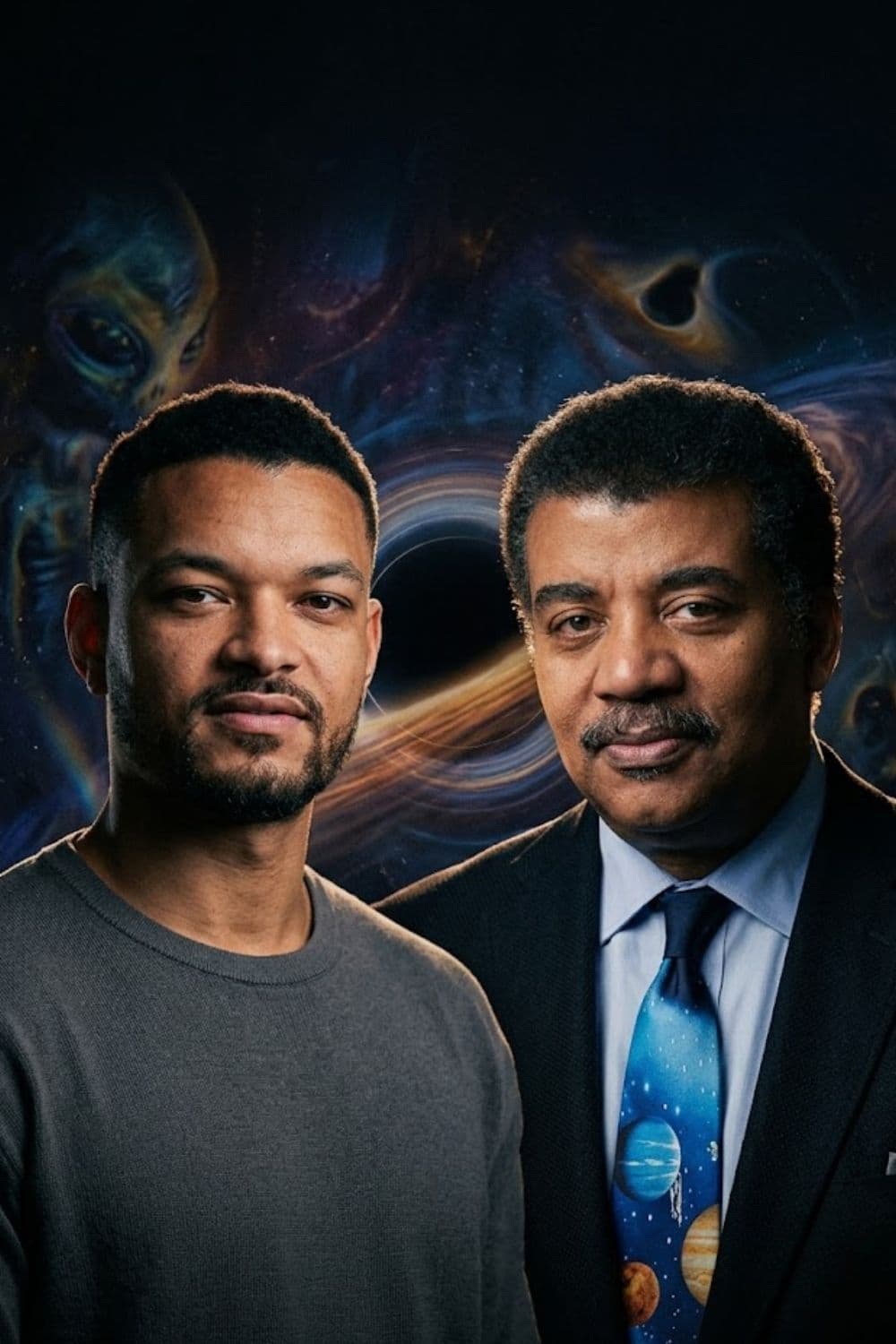
Steven Bartlett with Neil deGrasse Tyson
The traditional psychological response to the immense scale of the cosmos is often a sense of deep personal insignificance. However, Tyson presents a profound perspective shift, arguing that this reaction stems from an inflated ego. When we recognize that the chemical elements of our bodies, such as oxygen, carbon, nitrogen, and iron, were forged inside the hearts of high-mass stars that exploded at the end of their lives, the feeling of insignificance dissolves.
Instead of feeling small, Tyson suggests we should feel a grand sense of connectivity to the unfolding cosmic story. We are not merely passive observers in a cold universe; rather, the universe itself is chemically alive within us, making our existence an active, solar-powered extension of stellar evolution.
A recurring principle of physical reality is that the laws of physics manifest uniquely at different physical dimensions. It is impossible to simply scale up or down biological organisms without fundamentally altering how they interact with physical forces. For example, a heavy animal requires thick, chunky legs to support its mass, whereas an ant can survive a fall from a roof because gravity interacts differently with its tiny mass.
Similarly, at the microscopic level, forces like surface tension dominate over gravity. Fluids form stable beads and membranes that insects can interact with as physical structures, a phenomenon that macroscopic creatures only observe in limited contexts like waxed surfaces. This prevents the universe from being a simple series of nested dolls, as the physical requirements of life shift dramatically across the spectrum of size.
Human senses are not designed to detect the absolute nature of objective reality. Rather, they are narrow evolutionary tools optimized solely for the survival of our species. We lack the biological equipment to perceive infrared light, ultraviolet radiation, magnetic fields, or microscopic organisms, meaning our raw sensory experience misses vast domains of the physical world.
Science functions as a method to transcend these biological limitations by developing objective tools and sensors. Microscopes, telescopes, and radiation detectors allow us to gather repeatable data that is entirely independent of human retinas and neural synapses. By establishing measurements that exist outside our five senses, we move away from subjective illusion and closer to a shared, objective understanding of the physical environment.
When assessing the likelihood of life elsewhere in the cosmos, astronomers look to the raw materials and timelines of our own planet. Life on Earth emerged within a hundred million years of the planet becoming habitable, which is a tiny fraction of its total history. This rapid transition from organic chemistry to self-replicating organisms suggests that simple biology may occur readily given the right ingredients and planetary conditions.
However, the development of technological intelligence is a far slower process, requiring billions of years of evolutionary pressure. Given that modern telescopes have cataloged thousands of exoplanets in just a tiny neighborhood of our galaxy, and that there are hundreds of billions of galaxies in the observable universe, the sheer abundance of planetary systems suggests that even highly improbable evolutionary paths have ample opportunity to unfold.
Human attempts to define intelligence are often biased by a desire to place ourselves at the pinnacle of evolutionary achievement. Standard metrics like absolute brain size actually place humans behind whales, dolphins, and elephants. To counter this, humans historically relied on the ratio of brain mass to body mass, yet even this metric fails to distinguish us when applied outside of mammals, as small birds like magpies and parrots possess higher ratios.
Tyson suggests that a cosmic definition of intelligence must move beyond mere biology to focus on the capacity for technological communication and spatial travel. An alien civilization visiting Earth might view highly social, large-brained marine mammals as the primary intelligence, but they would seek civilizations with the technology to build telescopes, understand radio waves, or construct spacecraft. This operational threshold distinguishes simple biological intelligence from technologically communicative civilizations.
The popular philosophical speculation that we live in a computer simulation is often framed as a mathematical certainty. However, Tyson analyzes this scenario as a highly conditional thought experiment that depends on specific, unproven technological milestones. The classical simulation argument assumes a branching chain of universes where highly advanced civilizations construct computers capable of simulating conscious entities with free will, who in turn build their own simulated realities, creating an expansive tree of manufactured worlds.
Tyson introduces a critical caveat to this logic by examining our current technological capacity. Because humanity does not yet possess the computing power to simulate a universe containing conscious beings with perceived free will, we cannot be positioned in the middle of this hypothetical sequence. Therefore, if we assume the simulation framework is valid, we must logically occupy either the very first base reality that has not yet run a simulation, or the very last simulated node in a branch that has yet to develop this capability. This realization significantly shifts the speculative probabilities, leaving our reality as a potential origin point rather than a guaranteed digital illusion.
The physical foundation of a black hole lies in the concept of escape velocity, which is the specific speed required for an object to permanently break free from a gravitational body. On Earth, this speed is approximately seven miles per second. If a celestial body is compressed to a higher density, its surface gravity increases, thereby raising the speed required for any object, or even light, to escape its gravitational pull.
When a massive object becomes dense enough that its escape velocity equals or exceeds the speed of light, it crosses a critical threshold. Because nothing can travel faster than the speed of light, no matter, radiation, or information can ever escape its boundary. The object becomes a black hole, transforming from a highly massive star into a region of space where gravity has permanently sealed off a portion of the universe from the outside world.
As an observer approaches the event horizon of a black hole, the intense gravitational field dramatically distorts the fabric of space and time. According to Einstein's general theory of relativity, gravity causes time to tick more slowly relative to the distant universe, a phenomenon known as time dilation. For an individual descending toward the boundary, their internal perception of time remains normal, but the outside universe appears to accelerate.
Tyson notes that from this distorted perspective, the falling observer would watch the entire future history of the outer universe unfold at blinding speed as they cross the threshold. Space and time effectively fold back on themselves, removing any physical pathway that leads back to the external world and sealing the traveler's trajectory toward the core.
While the temporal effects of a black hole are mathematically profound, the physical reality of falling into one involves destructive gravitational differentials. On Earth, the gravity pulling at a person's feet is slightly stronger than the gravity at their head, but this difference is negligible to human biology. Near a black hole, however, these tidal forces become incredibly severe because the gravitational gradient steepens rapidly over short distances.
An object falling feet-first will experience an unrelenting, stretching force as the feet are pulled far more rapidly than the head. This gradient eventually overcomes the structural integrity of any material, snapping a human body into progressively smaller halves in a continuous process of bifurcation. Concurrently, as the falling mass approaches the infinitely dense point known as the singularity, the surrounding space narrows, extruding the material laterally and stretching it vertically like toothpaste through a tube.
The history of human spaceflight reveals that monumental cosmic endeavors are rarely driven by pure scientific curiosity. The original Apollo missions and the modern Artemis program are fundamentally geopolitical reactions to international competition. Rather than being motivated by a shared scientific mission, these major investments are sparked when a global competitor, such as China, announces plans to land on the moon, which ignites national egos and triggers security concerns.
This competitive dynamic acts as a powerful catalyst, uniting otherwise divided political bodies to fund massive space exploration initiatives. While scientific research and resource utilization are valuable secondary outcomes of these missions, the primary driver remains sovereignty, national prestige, and the race to establish a presence in the unclaimed territories of the lunar surface.
The rapid commercialization and militarization of low Earth orbit have led to an unprecedented rise in satellite deployments. While global communication networks provide immense economic and practical utility, they also create a crowded orbital environment that threatens future space access. High-velocity space debris, traveling at speeds exceeding seventeen thousand miles per hour, carries immense kinetic energy, turning even microscopic particles into destructive projectiles.
This density raises the risk of Kessler Syndrome, a theoretical threshold where a single collision between satellites creates a cloud of high-speed shrapnel. This shrapnel then strikes other satellites, triggering a runaway chain reaction of destruction that could systematically obliterate the entire orbital network. This self-replicating cascade would leave low Earth orbit completely unusable, highlighting the urgent need for international space management.
Tyson argues that searching for the meaning of life as if it were a physical object hidden under a rock is a fundamentally flawed approach. Meaning is not something to be discovered; it is something that conscious beings must actively create. For Tyson, this creative process is achieved through two main pursuits: expanding one's own wisdom by learning something new each day, and actively working to lessen the suffering of others.
This philosophy culminates in a call to prioritize educational curiosity over institutionalized rote learning, ensuring that the pursuit of knowledge remains a lifelong joy. True significance is not measured by monuments, statues, or personal fame, but by the positive impact left on humanity. This is encapsulated by the guiding principle that one should strive to win some victory for the human species before facing death, ensuring that the world is left in a better state than we found it.
Jump into the ideas before you finish the whole summary.