
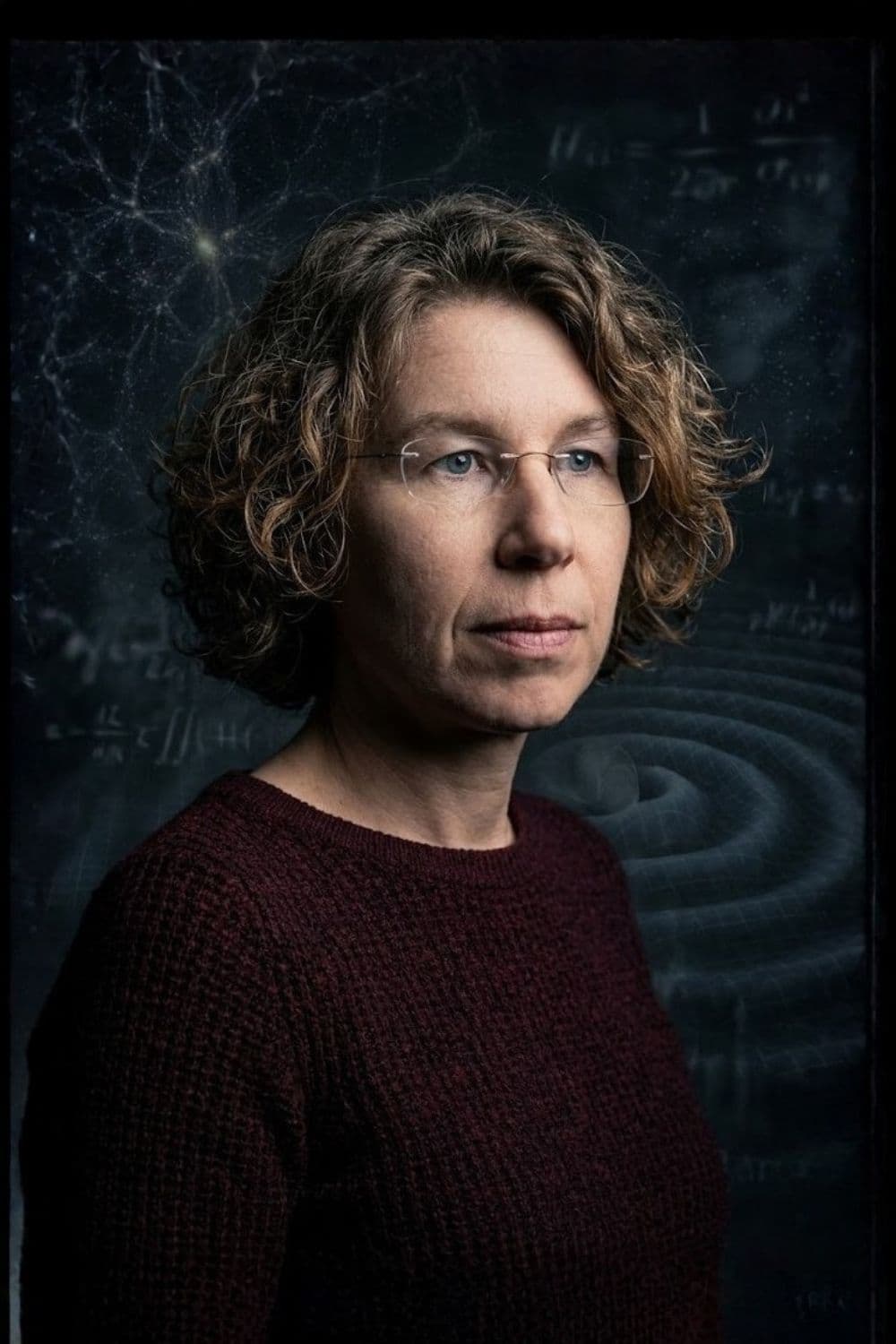
Sabine Hossenfelder
The theory of special relativity demonstrates that the speed of light is finite and constant for all observers. This finite speed dictates that everything perceived by the human eye is actually an image of the past, rendering the concept of a universal and simultaneous present moment physically impossible. Because different observers moving at varying speeds will fundamentally disagree on whether two events occur simultaneously, there is no unambiguous present moment. Space and time combine into a single geometric entity known as spacetime, forming a rigid block universe. In this framework, the past, present, and future exist simultaneously and equally, meaning the past remains as materially real as the present.
The fundamental laws of nature rearrange matter and radiation without destroying the underlying quantum information. Every particle interaction preserves the intricate details of its prior state, allowing a theoretical reconstruction of the past from the current physical configuration. When a person dies, the exact information constituting their physical and mental state disperses into subtle correlations and spreads throughout the solar system as escaping radiation. Because this quantum information is strictly conserved, human existence transcends the subjective passage of time, preserving the foundational blueprint of an individual permanently within the fabric of the cosmos.
Human behavior arises strictly from the interaction of fundamental particles governed by deterministic laws and occasional unpredictable quantum events. Because the exact physical state of the universe yesterday completely dictates the macroscopic state of the universe today, human decisions are the inevitable mathematical result of prior cosmic configurations. The subjective feeling of conscious free will occurs merely because individuals lack the computational capacity to anticipate the outcome of their own brain's neural processing before it finishes. Consequently, an independent choice uninfluenced by historical physical events is a logical and physical impossibility.
Quantum mechanics relies on two entirely incompatible dynamical laws. The smooth, deterministic evolution of a wave function described by the Schrödinger equation directly conflicts with the sudden, nonlinear update required when a measurement occurs. This measurement postulate suggests that a particle exists in a cloud of probability until observed, at which point its wave function inexplicably collapses into a definite state. If quantum mechanics were a truly fundamental theory of nature, the behavior of macroscopic measuring devices would naturally derive from the underlying equations without requiring a separate and contradictory collapse postulate.
Superdeterminism resolves the quantum measurement problem by introducing a deterministic and local hidden variables theory. This theoretical framework intentionally violates the assumption of statistical independence, meaning the time evolution of a prepared quantum state fundamentally depends on the precise settings of the detector used to measure it. By accepting that the observed quantum system and the macroscopic measuring device share a correlated physical history from the origin of the universe, superdeterminism reproduces all predictions of quantum mechanics. This removes the need for spooky action at a distance or the invention of multiple parallel universes.
Critics often argue that superdeterminism requires absurd cosmic conspiracies or extreme fine tuning to perfectly align particle states with detector settings. However, assuming that statistical independence must hold in quantum experiments simply because it functions adequately in classical physics is a profound logical fallacy. Superdeterminism possesses superior explanatory power because it derives the complex statistical phenomena of quantum mechanics from fewer, strictly local assumptions. Formulating exact superdeterministic theories, such as future bounded path integrals, allows physicists to test these hidden correlations empirically by looking for autocorrelations in sequential measurements of cold, isolated systems.
Reductionism asserts that the behavior of macroscopic objects can be entirely deduced from the properties and interactions of their microscopic constituents. Extensive empirical observation confirms this principle, showing absolutely no physical evidence for strong emergence, which is the theoretical idea that higher level systems exhibit properties completely detached from their underlying particle physics. Even highly complex phenomena like human consciousness are ultimately physical information processing systems running on biological hardware. Because consciousness depends entirely on the exact relational configurations of these physical particles, replacing biological neurons with artificial components that perfectly replicate those interactions would theoretically preserve the mind.
Modern theoretical physics frequently engages with highly speculative concepts like the multiverse, panpsychism, and the precise fine tuning of the universe for biological life. These ideas are categorized as ascientific because they postulate unobservable entities that are entirely unnecessary to explain actual physical phenomena. While physics cannot definitively disprove the existence of parallel universes or a minimally conscious cosmos, it completely lacks empirical data to support them. Treating purely mathematical possibilities as ontological facts creates a deeply misleading conflation between rigorous scientific methodology and speculative philosophical metaphysics.