
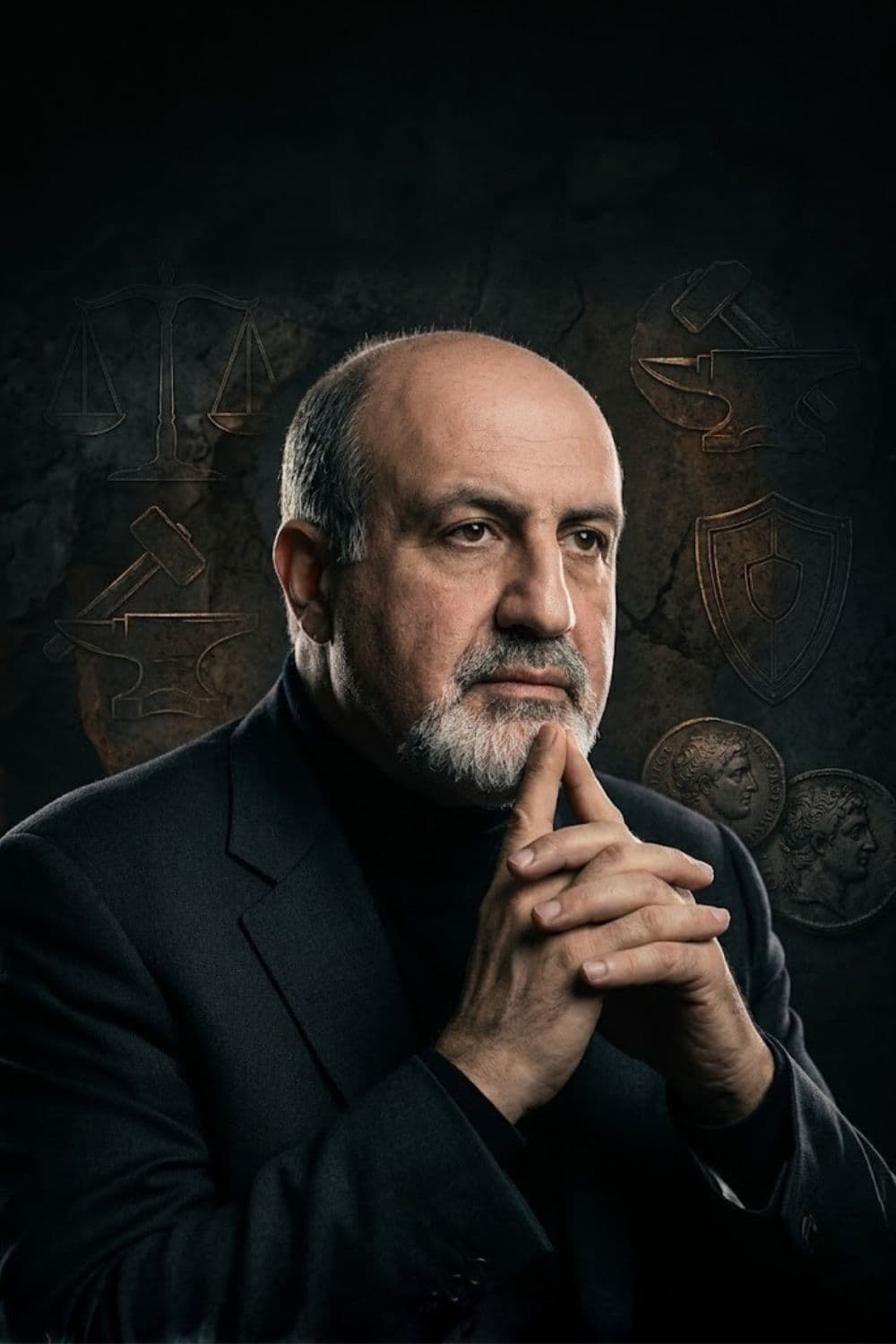
Nassim Nicholas Taleb
Individuals must bear a personal stake in the outcomes of their decisions to ensure systemic fairness and efficiency. When decision makers experience the direct consequences of their actions, they are naturally incentivized to make prudent and ethical choices. This exposure acts as a fundamental filter that removes bad actors and poor strategies from the environment. Without personal risk, individuals are prone to taking gambles that yield short term personal gains while exposing the broader system to catastrophic failure.
Bureaucracies and centralized systems inherently strip individuals of personal exposure to risk. Actors within these systems frequently transfer the cost of their mistakes to others while retaining the rewards. A corporate executive or government official who receives a bonus for temporary success but pays no penalty when their organization requires a public bailout operates completely insulated from reality. This asymmetry encourages reckless behavior and prevents the system from learning, ultimately guaranteeing a massive collapse.
Traditional economic and psychological models critically misunderstand risk by confusing the probabilities of a group with the probabilities of a single individual over time. If one hundred people visit a casino once, the overall win rate accurately reflects the mathematical odds. However, if one person visits the casino one hundred times in a row, a single total loss permanently removes them from the game. This constant threat of absolute ruin invalidates standard cost benefit analyses, as survival is the absolute prerequisite for any future success.
Complex systems are driven by the interactions of their parts rather than the averages of their populations. When a small but entirely inflexible minority refuses to compromise on a specific preference, the flexible majority will naturally conform to accommodate them. It is vastly more efficient for a food manufacturer to produce entirely kosher products than to run separate, segregated supply chains for a tiny fraction of consumers. Through this mechanism, a highly intolerant group representing a minuscule percentage of a population can completely dictate the rules of the entire society.
A distinct class of highly educated professionals dictates societal norms and government policies without ever experiencing the negative results of their directives. These individuals possess an overwhelming capacity to pass academic exams but lack the basic survival instincts forged by real world exposure. They routinely advocate for complex, destabilizing interventions, such as foreign regime changes or unproven dietary guidelines, and then remain completely unaffected when their theories cause devastating harm. Their primary flaw is an inability to grasp second order effects and a tendency to confuse superficial scientism with genuine, rigorous science.
Human beings suffer disproportionately more from a loss than they enjoy an equivalent gain. Consequently, avoiding negative outcomes is far more critical to long term survival than actively seeking positive ones. The most robust ethical guideline dictates that one should simply avoid doing to others what one would not want done to themselves. Telling people what to avoid removes the unpredictable, cascading side effects that inevitably accompany positive prescriptions.
The longevity of nonbiological entities like books, technologies, and religious practices directly predicts their future lifespan. Ideas and institutions that have survived for millennia have been ruthlessly tested against the random shocks and extreme volatility of history. Time acts as the ultimate judge, destroying fragile concepts while preserving those backed by genuine resilience and practical utility. Therefore, ancient heuristics and ancestral wisdom inherently possess a far superior track record compared to the fleeting theories generated by modern academics.
Ethical beliefs and religious convictions hold no actual value unless they demand genuine sacrifice. Authentic virtue requires individuals to take meaningful risks and suffer tangible costs for their principles, effectively separating true believers from those engaging in cheap social signaling. Actions performed in the face of adversity or ridicule provide the only legitimate proof of courage. When stripped of personal cost, declared values are nothing more than superficial displays designed to elevate status without assuming any real responsibility.
Jump into the ideas before you finish the whole summary.