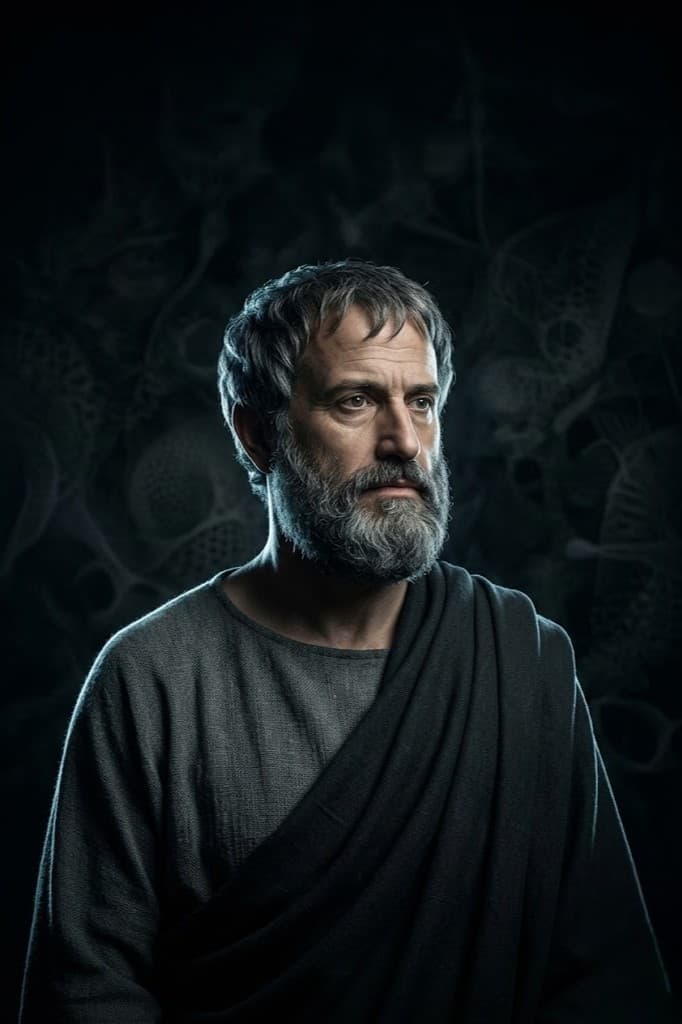
Aristotle
Aristotelian logic establishes the foundation for philosophical inquiry by examining how language maps onto reality. To understand being, one must analyze statements as cases of predication, where a predicate is attributed to a subject. The most fundamental subjects are primary substances, which are concrete individuals that exist independently and are never predicated of anything else. Secondary substances, such as species and genera, are predicated of these individuals. Attributes fall into other categories like quantity, quality, and relation, which depend ontologically on primary substances to exist.
This categorical structure is not merely a linguistic tool but a metaphysical map of reality. It reveals a strict hierarchy of dependence. If all individual concrete substances ceased to exist, all universal categories and properties would also vanish. Thus, the study of being qua being begins by isolating the concrete individual as the ultimate anchor of existence, distinguishing what something is fundamentally from the incidental properties it happens to possess.
To truly know a thing is to grasp its causes, which function as answers to the question of why a thing is the way it is. Aristotelian physical inquiry relies on four distinct explanatory factors. The material cause identifies the underlying matter out of which something is made. The formal cause provides the definition or essence, capturing the pattern that gives the matter its specific identity. The efficient cause points to the primary source of change or rest. Finally, the final cause identifies the end or purpose for the sake of which the thing exists.
In artificial objects, these four causes are easily distinguished, as the artisan imposes a pre existing form onto raw material for a specific external purpose. In the natural world, however, the formal, efficient, and final causes frequently coincide. The essence of a living organism is simultaneously its form, its internal principle of development, and the mature state toward which it naturally grows.
Nature operates with inherent directionality, meaning that natural objects possess internal final causes. Unlike the external purposes imposed on artifacts by human artisans, the final cause of a plant or animal is the fully actualized state of its own species. Developing organisms undergo a regular series of changes aimed at reaching maturity and fulfilling the characteristic functions of their kind. This teleology is not driven by conscious deliberation or a divine mind but by the internal logic of the organism itself.
This internal purposiveness is balanced by conditional necessity. While the material composition of an organism necessitates certain physical behaviors, these materials are present on the condition that they serve the organism's function. Heavy bones naturally fall or weigh a creature down, but dense bone exists in the first place to support the animal's structure. The material properties are necessary constraints, but the end goal governs why those specific materials are gathered and organized in that particular way.
The concept of substance in the natural world requires a synthesis of form and matter, a doctrine known as hylomorphism. Matter is the indeterminate potential out of which a thing is made, while form is the organizing principle that actualizes that potential into a specific, discrete entity. Strip away all properties, and one is left with an unknowable prime matter. Observe a pure form without matter, and one finds an abstract universal rather than a concrete individual. A natural substance must be a composite of both.
This composite nature explains how substances maintain their identity through physical change. When a green leaf turns brown, the underlying substance persists while losing one accidental form and gaining another. When a seed becomes a tree, the matter transitions from possessing the mere potential for life to actively exercising it. Form is the explanatory priority because it defines what the matter is doing and why it is structured as it is.
To resolve ancient paradoxes about how change is possible without claiming that something comes from nothing, existence must be divided into potentiality and actuality. Potentiality represents a thing's latent capacity to undergo a specific change or perform a particular function. Actuality is the fulfillment or active exercise of that capacity. A sleeping musician possesses the potential to play an instrument, while a waking musician actively playing embodies the actuality of that skill.
Change is therefore defined as the transition from potentiality to actuality. Crucially, actuality is logically and temporally prior to potentiality. A potential can only be defined by the actual state it aims to reach, and it requires a pre existing actuality to trigger its development. A seed has the potential to become a tree, but it required an actual, mature tree to produce it.
Because all motion and change in the cosmos require a prior actuality to initiate them, the chain of causation cannot stretch infinitely backward. There must be a primary source of motion that is not itself subject to change. This ultimate principle is the Unmoved Mover, a pure actuality entirely devoid of potentiality, matter, or physical composition. Because it lacks potentiality, it cannot be altered, generated, or destroyed.
The Unmoved Mover does not push the universe mechanically. Instead, it causes motion as an object of desire and love. All natural things strive to actualize their own potential and achieve their highest state of being, effectively imitating the perfect, eternal activity of the Unmoved Mover. This divine entity exists in a state of perpetual contemplation, thinking only of the highest possible object of thought, which is itself.
Psychology and biology are inseparable because the soul is defined strictly as the first actuality of a natural body that potentially has life. The soul is not a distinct spiritual substance trapped in a material vessel but the formal cause of the living organism. It is the functional organization that allows a body to nourish itself, perceive, desire, and think. A corpse looks like a human body but lacks a human soul, meaning it is only a human body in name, as it has lost the capacity to perform human functions.
Psychological powers are arranged in a strict, cumulative hierarchy. The nutritive soul governs growth and reproduction and is shared by all living things, including plants. The perceptive soul, which enables sensation and desire, is found in all animals. The rational soul is unique to human beings, adding the capacities for intellect, judgment, and abstract understanding. Each higher level of the soul subsumes and relies upon the lower levels to function.
The ultimate aim of human life is eudaimonia, commonly translated as happiness but more accurately understood as flourishing or successful living. This goal is not a passive emotional state or a fleeting feeling of pleasure. It is an active condition. Just as the function of a flutist is to play the flute excellently, the distinctive function of a human being is to exercise the rational soul. Eudaimonia is therefore the active exercise of the soul in accordance with excellence or virtue over the course of a complete life.
Pleasure is not the goal of life but the natural byproduct of exercising one's capacities well. The good life is inherently pleasurable because the virtuous person has been conditioned to take joy in noble actions. However, achieving this state is not entirely immune to external circumstances. While virtue provides resilience against misfortune, a truly flourishing life requires a baseline of external goods, such as health, resources, and friendship, to fully actualize one's potential.
Human excellence is divided into intellectual virtues, which are learned through instruction, and moral virtues, which are acquired through habituation. A person does not possess moral virtue by nature but develops it by repeatedly performing virtuous actions until they become second nature. One becomes just by doing just deeds and brave by doing brave deeds. Character is the settled disposition that arises from these repeated actions, determining how one feels and responds to various situations.
Moral virtue consists in finding a mean between two extremes of excess and deficiency, relative to the individual and the circumstance. Courage, for example, is the precise mean between the excess of recklessness and the deficiency of cowardice. This mean is not a mathematical average but a calibrated response dictated by practical reason. A virtuous disposition ensures that a person feels the appropriate emotions at the right times, toward the right objects, and in the right manner.
The intellectual virtue that makes moral virtue possible is practical wisdom or phronesis. While theoretical wisdom concerns eternal and unchanging truths, practical wisdom navigates the contingent, variable realm of human action. It is the capacity to deliberate well about what promotes the good life and to translate those deliberations into concrete choices. Without practical wisdom, good intentions can easily result in misguided actions.
Deliberation never concerns the ultimate ends themselves, as those are already set by human nature and desire. Instead, deliberation focuses entirely on the means to achieve those ends. It functions like a backward search, starting from a desired outcome and calculating the steps necessary to bring it about, ending with an action the agent can perform immediately. Excellence in action requires both a virtuous character to desire the right end and practical wisdom to select the correct path to reach it.
The individual human being cannot be understood in isolation because humans are naturally political animals. The city state or polis is not an artificial construct created by a social contract but a natural outgrowth of human needs, progressing from the family to the village and finally to the self sufficient political community. While the individual is temporally born first, the state is logically and naturally prior to the individual, just as a whole body is prior to a single organ. An organ cannot perform its function without the body, and a human cannot achieve true flourishing outside a political community.
The unique human capacity for speech demonstrates this political nature. Unlike animal vocalizations that merely signal pain or pleasure, human language can articulate concepts of justice, injustice, expediency, and harm. The ultimate purpose of the state is not merely to facilitate economic exchange or provide physical security, but to ensure the good life for its citizens. A well ordered society uses laws and education to cultivate virtue, aligning the success of the individual with the harmony of the whole.
Art and poetry are deeply rooted in the human instinct for mimesis, or imitation. Unlike history, which merely records isolated and contingent events, poetry elevates human action by focusing on universal truths. Through the imitation of reality, poetry allows audiences to safely observe and learn from distressing situations. The value of a narrative lies in its plot, which must be a unified, logically connected sequence of events with a definitive beginning, middle, and end.
In the highest form of poetry, tragedy, the plot portrays a relatively noble character passing from fortune to misfortune due to a critical error. The logical progression of the plot forces the knot of circumstances to tighten until a sudden reversal or discovery unravels it. Witnessing this inevitable sequence arouses pity and fear in the audience, culminating in a catharsis. This purging or clarification of emotions allows the audience to experience intense feeling with cognitive detachment, ultimately deepening their understanding of human vulnerability and moral order.
Jump into the ideas before you finish the whole summary.