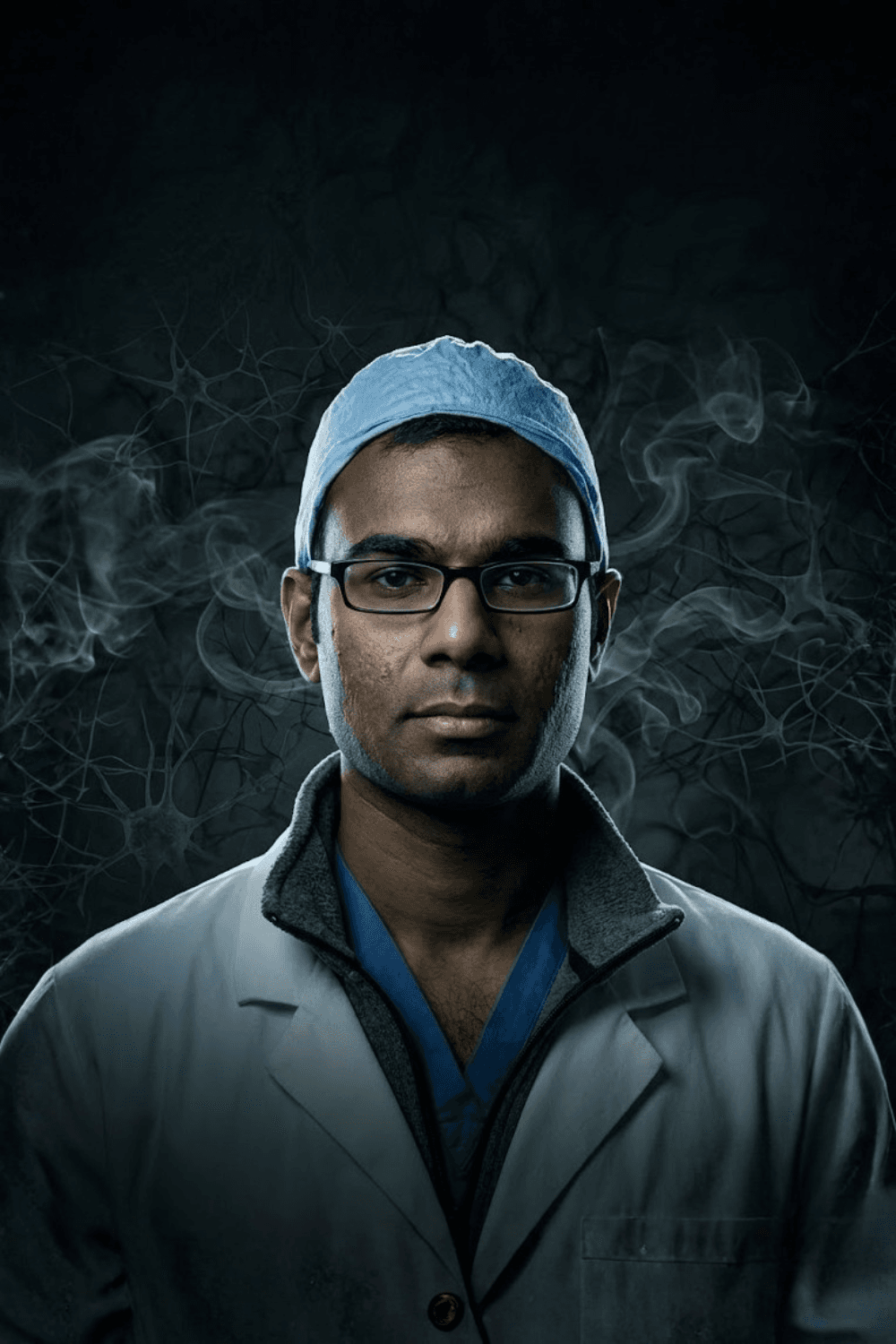
Paul Kalanithi
The intellectual foundation of the narrative rests on the conviction that human meaning cannot be captured by a single discipline. Literature provides the vocabulary for the life of the mind, mapping the emotional and philosophical dimensions of human experience. Biology and neuroscience, conversely, reveal the physical substrate that makes such experiences possible. True comprehension of mortality and consciousness requires bridging this divide, recognizing that the self is simultaneously a biological mechanism and a construct of language.
Neurosurgery operates at the exact point where physical matter generates identity. Surgical interventions in the brain are never purely technical problems, as altering the tissue can fundamentally change a person's speech, memory, and personality. The physician bears a profound moral responsibility to understand what makes a specific patient's life recognizable and valuable to them. Success is not merely extending a biological lifespan, but preserving the core essence of the individual against the threat of neurological erasure.
A central tension exists between the clinical knowledge of disease and the subjective experience of suffering. A physician may possess total fluency in the anatomy of pain, the mechanisms of cellular mutation, and the statistical probabilities of survival. However, this theoretical mastery offers no preparation for the visceral reality of being a patient. The transition from doctor to patient exposes a profound epistemic schism, revealing that medical training equips one to manage disease from the outside while leaving one entirely defenseless against the internal, existential disorientation of dying.
Medical training and modern ambition rely entirely on the concept of delayed gratification and a predictable, linear future. This framework assumes that intense present sacrifice will eventually yield decades of stable achievement and comfort. A terminal diagnosis violently shatters this timeline, exposing the assumption of a future as a fragile privilege rather than a guaranteed right. The collapse of this trajectory forces a radical restructuring of daily existence, as the logic of long term investment gives way to the brutal contingency of the immediate present.
When the linear progression of a life is halted, time ceases to be a runway for future plans and transforms into an oppressive psychological environment. Uncertainty regarding whether one has weeks, months, or years left becomes its own distinct form of suffering. The inability to quantify remaining time paralyzes the ability to make decisions. Without a stable temporal horizon, ordinary choices become impossible, forcing a shift from experiencing time as a measurable resource to enduring it as an unpredictable state of being.
In the face of fatal illness, the intense desire for statistical certainty becomes a trap. Survival curves and median life expectancies provide a mathematical illusion of control but fail to deliver any actual existential guidance. Prognostic numbers cannot dictate how a person should spend their remaining days or what constitutes a meaningful end. Good medical care must therefore resist the urge to offer false precision, focusing instead on helping the patient navigate the ambiguity of their condition while preserving their emotional agency.
When a defining vocation is stripped away by physical decline, the self faces a profound crisis of identity. The individual must transition from a position of authority and action into a state of vulnerability and dependency. This loss of utility threatens the very narrative a person constructs about their worth. Surviving this crisis requires detaching one's core identity from physical capabilities and professional achievements, rebuilding a sense of self rooted in internal values, relationships, and the capacity to bear witness to one's own unraveling.
The approach to end of life decisions is deeply influenced by the rejection of comfort as the ultimate goal of human existence. Choosing to bring a new child into the world despite the absolute certainty of impending grief illustrates a central philosophical stance. Avoiding pain cannot be the guiding principle of a life worth living. Embracing profound vulnerability and inviting inevitable sorrow are necessary costs for creating deep connections, proving that meaning is forged through courageous commitments rather than defensive retreats.
Returning to demanding, highly skilled labor while terminally ill is an act of existential resistance. Stepping back into the operating room is not a symptom of denial, but a deliberate strategy to remain recognizable to oneself while the body fails. Work reclaims its status as a moral practice. By choosing to serve others within shrinking physical boundaries, the individual asserts that purpose and dignity can be actively sustained even as the biological timeline rapidly accelerates toward its conclusion.
The clinical encounter is fundamentally incomplete if it relies solely on chemical and surgical interventions. True healing requires acknowledging the profound social, emotional, and psychological injuries inflicted by disease. A physician must build the capacity to listen to and interpret the patient's narrative, recognizing the metaphors and fears that shape their suffering. Bearing witness to a patient's story bridges the gap between scientific detachment and human empathy, transforming medical care from a mechanical transaction into an act of mutual recognition.
When the physical capacity to heal others evaporates, language remains the final instrument of purpose. Writing functions as a second operating room, a space to carefully dissect the chaos of mortality and articulate the anatomy of meaning. The written word offers a mechanism to outlast the failing body, translating ephemeral pain and hard won wisdom into a permanent record. This translation ensures that the intellect and the spirit survive the biological collapse, providing guidance and connection for those who remain.
The ultimate architecture of the text reflects the reality it describes by ending without complete closure. A terminal illness interrupts the project of living abruptly, denying the dying the comfort of a neatly resolved conclusion. Accepting an unfinished manuscript mirrors the acceptance of a truncated life. It serves as a final argument that meaning does not depend on longevity or perfect completion, but is continually constructed through the daily practice of chosen commitments, honest reflection, and enduring love.
Jump into the ideas before you finish the whole summary.