
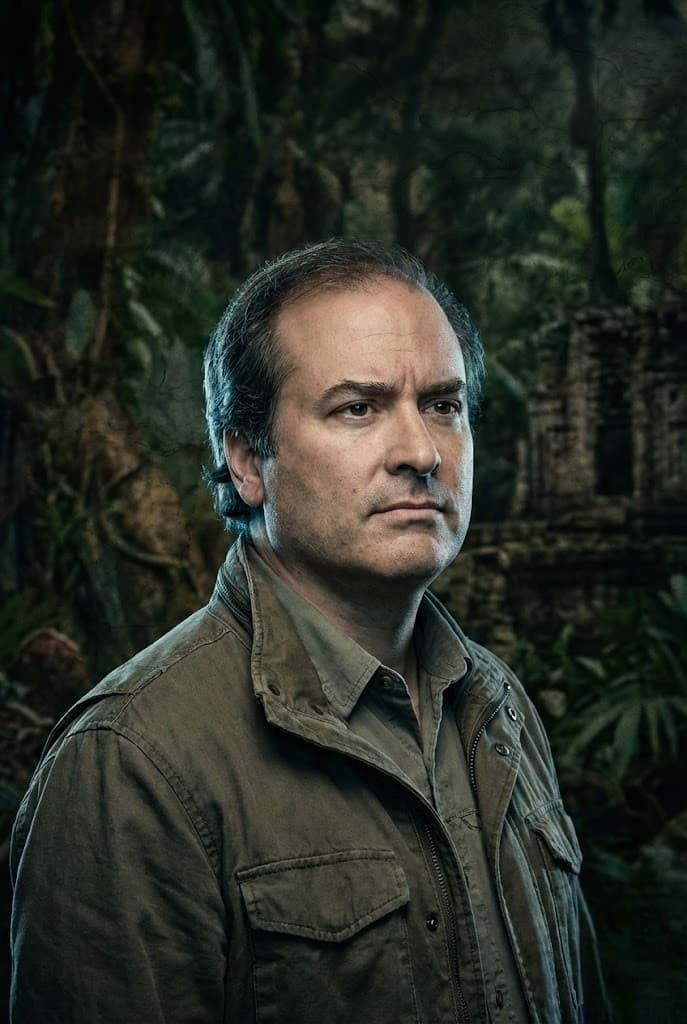
David Grann
Percy Harrison Fawcett, a British artillery officer and former Secret Service spy, spent two decades exploring the Amazon basin. He became convinced that an advanced ancient civilization, which he named Z, lay hidden in the Mato Grosso region of Brazil. In 1925, at the age of 57, Fawcett embarked on a final expedition with his son Jack and Raleigh Rimell. The group vanished after leaving Dead Horse Camp, sparking a mystery that would subsequently claim the lives of an estimated one hundred searchers.
During Fawcett's era, the scientific establishment broadly dismissed the Amazon basin as a counterfeit paradise incapable of sustaining large, complex societies. Experts argued that heavy rainfall and flooding would quickly strip the soil of nutrients, making large-scale agriculture impossible. Fawcett rejected this consensus. He observed healthy, populous indigenous groups living far from major rivers, geometric earthworks, and widespread pottery shards, interpreting these signs as evidence of a massive historical population.
Fawcett built his theory of Z on both direct observation and historical texts. He relied heavily on Manuscript 512, an eighteenth-century document written by Portuguese fortune hunter Joao da Silva Guimaraes. This manuscript described a ruined, ancient city featuring a statue, stone arches, and hieroglyphic inscriptions.
Combined with sixteenth-century accounts from Spanish conquistadors who reported vast settlements along the Amazon River, these clues convinced Fawcett that a sophisticated empire had existed without any Western intervention. He believed finding this city would fundamentally alter the Western perception of human history and civilizational development.
Modern investigations suggest Fawcett's expedition ended violently due to his dismissal of local intelligence. According to the oral history of the Kalapalo tribe, who inhabit the area near Dead Horse Camp, Fawcett and his companions ignored explicit warnings about traveling eastward into territory controlled by hostile warriors.
The Kalapalo observed the explorers' campfire for five nights before it abruptly vanished. This evidence strongly implies that the men were intercepted and killed by the neighboring tribe after stubbornly marching into forbidden territory.
Recent archaeological excavations in the Upper Xingu region reveal that Fawcett was searching in the correct location but looking for the wrong type of civilization. Rather than a glittering city of stone and gold, the Amazon hosted a dispersed, multicentric form of urbanism.
These pre-Columbian societies organized into galactic clusters, where a network of highly planned plaza towns and smaller villages gravitated around an exemplary political and ritual center. These settlements integrated defensive ditches, wooden palisade walls, and extensive raised road networks that aligned with specific astronomical and geometric principles.
The inhabitants of these galactic clusters engineered their environment to support regional populations exceeding fifty thousand people. They created overlapping zones of acute human influence, alternating between densely populated residential centers, agricultural countryside, and managed wetlands utilized for fish farming.
The intentional cultivation of anthropogenic dark earth and sprawling orchards allowed these complex societies to thrive in the dense tropical forest. This semi-intensive land management fundamentally challenges the assumption that the Amazon was a pristine, untouched wilderness prior to modern industrialization.
The monumental settlements of the Amazon basin did not collapse from ecological failure or an inability to adapt to the jungle. The arrival of Spanish conquistadors in the early sixteenth century introduced European diseases to which the indigenous populations possessed no immunity.
These pathogens decimated the local inhabitants long before explorers like Fawcett reached the interior. Without vast populations to maintain the complex earthworks and wooden structures, the jungle rapidly reclaimed the towns, leaving only subtle geometric landscape scars and pottery shards behind for future explorers to misinterpret.