Steve Peters
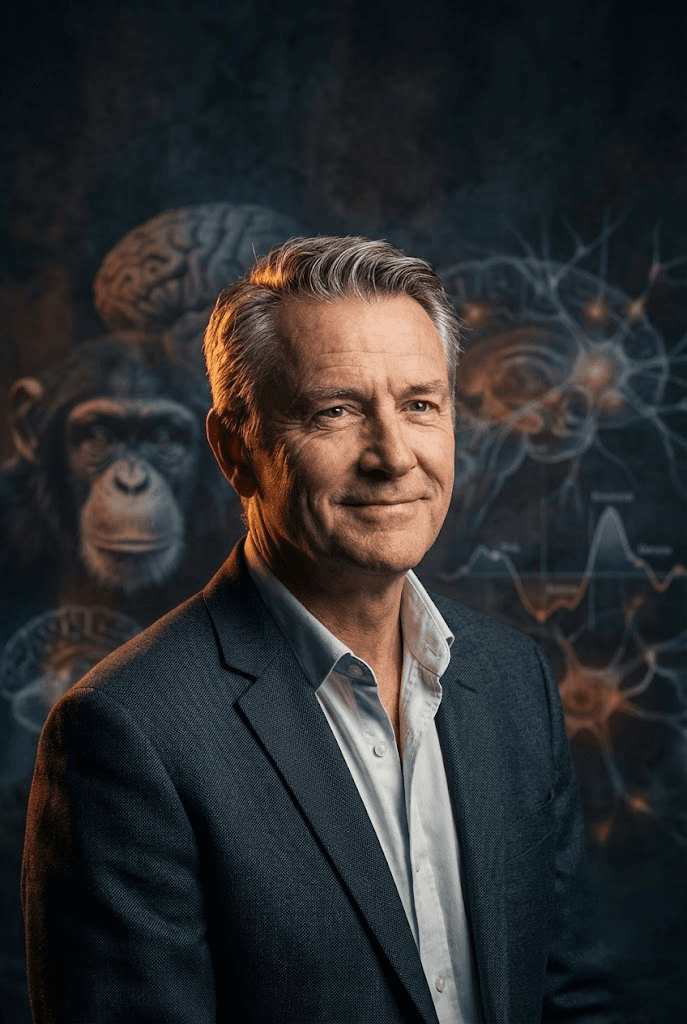
The internal architecture of the mind is divided into three distinct psychological systems that continuously interact and often compete for control. The Human, residing in the frontal lobe, represents rational and conscious thought. The Chimp, located in the limbic system, functions as an emotional and instinctual machine. The Computer, distributed across the parietal lobe and other areas, acts as a deeply programmed storage center for habits and beliefs. Rather than functioning as a unified whole, these three entities possess different agendas and operational modes, effectively operating as independent beings within a single brain.
The Chimp is an emotional machine driven fundamentally by survival, safety, and primal gratification. It processes information rapidly by relying on feelings, impressions, and intuition, which often causes it to jump to conclusions and perceive situations in stark black and white. Because the Chimp operates independently of conscious logic, it generates thoughts and emotional responses that the rational mind might find entirely unwelcome or inappropriate.
However, the Chimp is neither inherently good nor bad. It is merely an ancient biological mechanism designed to protect the individual, meaning its immense power can serve as either a vital asset or a destructive force depending on how it is managed. A failure to recognize that the Chimp possesses its own independent personality inevitably leads to severe emotional hijacking.
In contrast to the reactive Chimp, the Human operates as the center of logic, objective analysis, and rational decision making. The Human processes information by gathering evidence, seeking absolute truth, and understanding nuance and context. Its primary agenda extends beyond mere survival, focusing instead on long term psychological fulfillment, purpose, and the execution of moral principles.
When the Human is in control, an individual exhibits calm, evidence based reasoning, allowing them to act as the person they genuinely wish to be rather than a hostage to sudden emotional reactions. The critical distinction in cognitive behavior is that the Human searches for facts and truth before drawing a conclusion, whereas the Chimp starts with an emotional conclusion and then hunts for evidence to validate it.
The Computer serves as the mind's central reference library and automatic functioning system. Both the Human and the Chimp continuously consult the Computer before making decisions, relying on its stored experiences, learned behaviors, and deeply ingrained beliefs to interpret new situations. Because the Computer executes preprogrammed responses far faster than conscious thought, it provides crucial stability and efficiency in daily life. However, the quality of these automatic responses depends entirely on the information that the Human and the Chimp have previously installed into the system.
The programming within the Computer consists of distinct psychological constructs that dictate automatic reactions. Autopilots are constructive, helpful beliefs that automatically guide behavior toward positive outcomes. In contrast, Gremlins are unhelpful or destructive beliefs that sabotage success and generate unnecessary anxiety. A more entrenched version of a destructive belief is a Goblin, which represents a deeply fixed, highly resistant negative pattern.
The primary mechanism for improving mental functioning involves deliberately identifying and removing Gremlins, replacing them with efficient Autopilots. This continuous reprogramming is necessary because it relieves the slow moving Human of the constant burden of policing the impulsive Chimp.
At the very core of the Computer lies the Stone of Life, an immutable set of fundamental values and beliefs that an individual uses to anchor their existence. The programming on this stone dictates a person's overarching mindset, which is formed by answering three critical questions regarding how one sees oneself, how one sees others, and how one sees the world.
Dysfunctional programming here leads to destructive paradigms, such as the Snow White mindset of chronic victimhood or the Alpha Wolf mindset of aggressive dominance. Cultivating a healthy Stone of Life requires adopting rational, realistic principles, such as accepting that the world is inherently unpredictable and that personal happiness is a deliberate choice rather than a condition dependent on others.
Because the Chimp operates as an independent emotional machine, it cannot be ignored or bullied into submission. Effective management requires a structured sequence of techniques designed to calm the emotional brain before logical reasoning can take place. The first step involves exercising the Chimp, which means allowing it to express its raw emotions and anxieties in a safe, appropriate environment until it exhausts its initial reactive energy.
Once the Chimp is entirely calm, it must be boxed in with undeniable facts and rational logic. Finally, the Chimp is offered a banana, which represents a small treat, reward, or incentive that motivates the emotional brain to cooperate with the Human's long term objectives.
The evolutionary drive to belong to a community is strong in both the Chimp and the Human, but true emotional security requires the careful curation of a personal Troop. A Troop is a highly selective, small group of nurturing and supportive individuals who share mutual trust and facilitate personal development.
Attempting to bring everyone into this inner circle is a psychological error that exposes a person to severe emotional harm and conflict. While it is necessary to remain approachable and personable to the wider society, recognizing that not everyone belongs in the personal Troop protects both the Chimp and the Human from the inevitable reality that universal approval is impossible.
Conflicts routinely arise when a Chimp hijack dictates the flow of conversation, transforming a collaborative search for a solution into a rigid battle for emotional dominance. Effective interaction requires bypassing the emotional brain entirely to establish a rational connection.
This is achieved by mastering the square of communication, a framework ensuring that discussions occur at the right time, in the right place, with the right agenda, and in the right way. When communication is meticulously prepared to eliminate perceived threats, the opposing Chimp remains dormant, allowing both parties to logically navigate toward a sensible, mutually beneficial outcome.
The psychological model differentiates between instant stress, which triggers an immediate emotional derailment, and chronic stress, which occurs when unresolved anxieties become normalized over time. Instant stress is mitigated by actively slowing down the thought process, pausing to gain perspective, and formulating a calm plan before the Chimp can execute a blind panic response.
Chronic stress frequently stems from self inflicted Gremlins, such as the Mushroom Syndrome, where an individual allows worry to expand and consume all available mental space. Resolving deep seated stress requires overwriting these internal Gremlins with rational Autopilot beliefs, reinforcing the reality that worrying rarely alters outcomes and that deliberate relaxation is a powerful restorative tool.
Jump into the ideas before you finish the whole summary.