
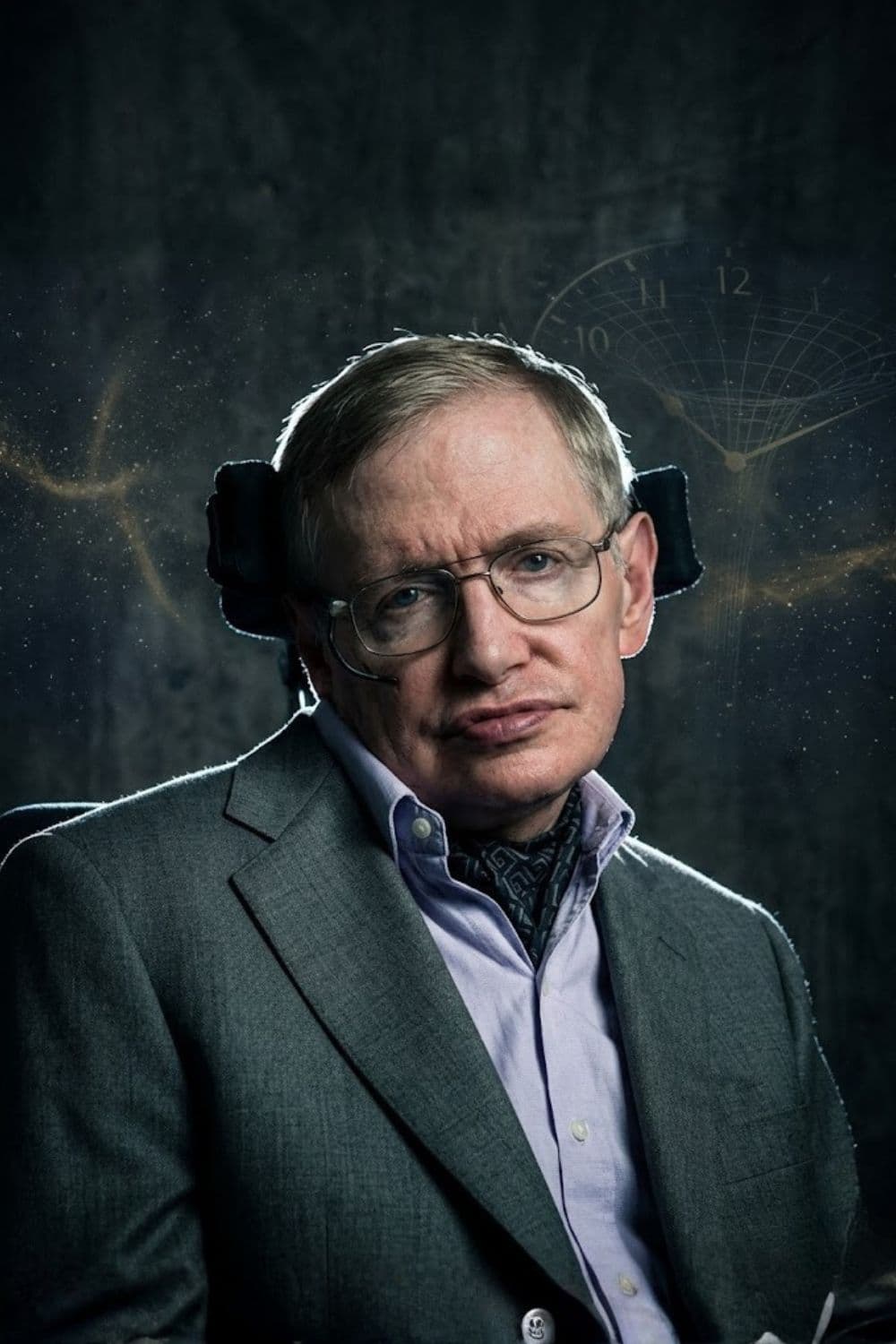
Stephen Hawking
Aristotle and Newton believed in absolute time, a uniform measure consistent for all observers across the universe. Newton dismantled absolute rest by showing that motion is determined by forces rather than an object's weight. Albert Einstein revolutionized this entire framework with his special and general theories of relativity. General relativity proved that gravity is not an invisible force pulling objects, but rather a curving of space and time caused by mass. Because space and time are dynamic and intertwined, time moves differently for observers depending on their speed and proximity to a gravitational field.
Edwin Hubble discovered that galaxies are moving away from Earth, with their speed proportional to their distance. This observation proved the universe is expanding, overturning the long held belief in a static cosmos. By extrapolating this expansion backward, scientists deduced the Big Bang theory, which states that the universe began as a point of infinite density and heat known as a singularity. At this singular point of creation, all known laws of physics break down.
Classical physics operated on the assumption of strict determinism, where knowing the exact state of the universe allows complete prediction of its future. Werner Heisenberg shattered this assumption with the uncertainty principle, demonstrating that one cannot simultaneously measure a particle's exact position and velocity with absolute precision. Quantum mechanics shifted science from absolute predictability to probabilities, revealing that subatomic particles exhibit both wave and particle behaviors depending on how they are observed.
When massive stars exhaust their nuclear fuel, gravity forces them to collapse into black holes. These objects possess an event horizon, a boundary where gravitational pull is so intense that not even light can escape. Quantum fluctuations near this event horizon cause black holes to emit thermal energy known as Hawking radiation. This process allows black holes to gradually lose mass and eventually explode, proving that they are not completely inescapable and that they possess entropy directly proportional to their surface area.
Time moves strictly forward due to three distinct directional arrows. The thermodynamic arrow relies on the second law of thermodynamics, which mandates that isolated systems move from order to disorder. The psychological arrow aligns with this thermodynamic flow, as human memory records the past but not the future because the brain consumes energy and increases overall cosmic disorder when forming memories. The cosmological arrow represents the physical expansion of the universe, which currently aligns with the other two arrows to create the exact conditions necessary to sustain intelligent life.
Because general relativity dictates that gravity curves space and time, it is theoretically possible for space to loop back on itself to permit time travel. To circumvent the universal speed limit of light, theorists propose the existence of wormholes, which act as structural shortcuts connecting distant regions of space and time. However, keeping a wormhole stable and open requires astronomical amounts of negative energy. Furthermore, the chronology protection conjecture suggests that physical laws actively conspire to prevent macroscopic objects from traveling backward in time, thereby preventing temporal paradoxes and preserving the consistency of history.
The two foundational pillars of modern physics conflict fundamentally with each other. General relativity perfectly describes the macroscopic universe of stars and gravity, while quantum mechanics accurately governs the microscopic world of subatomic particles. Scientists seek a single unified theory to bridge this mathematical gap. String theory proposes that the fundamental ingredients of reality are vibrating one dimensional strings rather than point particles. This framework requires the existence of multiple extra dimensions that remain tightly compacted and unobservable in our daily reality.
To resolve the breakdown of physical laws at the Big Bang singularity, the no boundary proposal utilizes the concept of imaginary time. This mathematical model frames the universe as finite but completely self contained, lacking any definitive edge or singular beginning. This framework removes the necessity of a divine creator initiating the cosmos at a specific moment. Philosophical interpretations suggest this model simply shifts the concept of a creator from a cosmic initiator to an immanent presence that sustains the physical laws themselves.
Astronomical observation has drastically expanded human knowledge of the cosmos over the last few decades. By observing distant supernovae, scientists discovered that the expansion of the universe is actually accelerating. This acceleration is driven by dark energy, an unknown repulsive force that counteracts gravity and constitutes the majority of energy in the universe. Additionally, researchers have successfully detected gravitational waves, confirmed the existence of the Higgs boson, and cataloged thousands of exoplanets, validating decades of theoretical physics.
Jump into the ideas before you finish the whole summary.