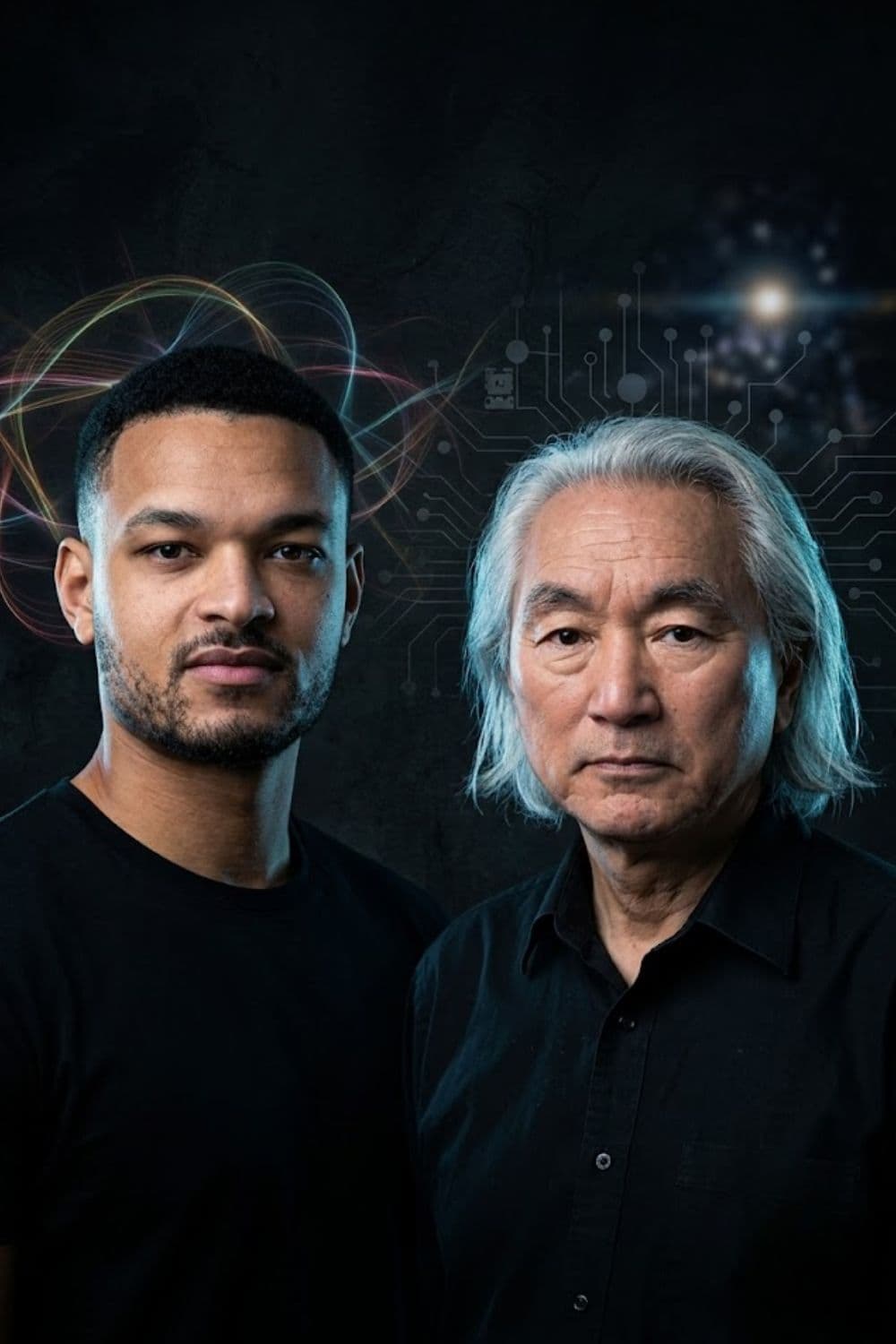
Steven Bartlett with Dr Michio Kaku
Kaku introduces string theory as the missing framework that eluded Albert Einstein, aiming to unite the four fundamental forces of nature into one elegant equation. In this model, subatomic particles like electrons and protons are not fixed points but rather vibrating strings. The specific frequency or mode of vibration determines the nature of the particle. Kaku suggests that this framework also accounts for dark matter, proposing it is simply a higher, invisible octave of string vibration that interacts with gravity but not light.
Expanding beyond the traditional Big Bang model, the discussion frames our universe as just one expanding bubble in an eleven-dimensional space. Kaku describes a cosmic bubble bath where multiple universes constantly pop into existence and annihilate. Rather than a singular explosion from nothing, this continuous quantum frothing suggests that our reality is part of a much larger, dynamic multiverse where pure nothingness is actually teeming with energetic activity.
The pursuit of biological immortality centers on telomeres, which function as cellular clocks that shorten each time a cell divides. Kaku explains that an enzyme called telomerase can stop this clock, theoretically allowing human cells to live forever. However, a profound biological tension exists. Cancer cells also utilize telomerase to achieve their own form of biological immortality, replicating endlessly until they kill the host. The central challenge of biological life extension is harnessing this mechanism to halt human aging without simultaneously awakening lethal cancers.
Alongside biological life extension, the discussion points toward a form of digital or cybernetic permanence. As artificial intelligence advances from insect-level processing to primate-level cognition and beyond, humanity faces a profound existential challenge. Rather than merely competing with or being replaced by hyper-intelligent machines, Kaku argues that our ultimate survival strategy is to physically merge with them. By integrating the human brain with advanced robotics and central nervous systems, humanity could achieve superhuman abilities and secure a digital pathway to outlast our biological limitations.
A fundamental distinction between human and animal consciousness lies in the brain's capacity to simulate the future. Kaku argues that while animals are locked in the present moment, driven purely by immediate survival needs, the human cerebral cortex functions as a future-prediction machine. Because humans evolved without physical advantages like claws, fangs, or supreme speed, our survival depended entirely on our ability to obsessively plot, plan, and anticipate future events. This constant predictive modeling is the evolutionary foundation of human intelligence.
Despite the rapid advancement of artificial intelligence, Kaku draws a sharp distinction between current AI models and true human creativity. He argues that modern AI is fundamentally imitative, generating outputs by rearranging existing data rather than conceptualizing entirely new paradigms. In contrast, human intellect is capable of original thought, such as Isaac Newton inventing calculus from scratch to explain planetary motion. While AI can simulate intelligence and accelerate discoveries based on past data, true conceptual breakthroughs still require the unique associative leaps of the human mind.
The impending transition from digital to quantum computing represents a paradigm shift that Kaku warns will disrupt global security. Traditional computers rely on binary transistors constrained to states of zero or one. Quantum computers calculate using individual atoms, which can occupy an infinite number of states between zero and one. Kaku notes that this exponential leap in processing power will eventually render all modern digital encryption obsolete, potentially destabilizing financial systems and national security infrastructure unless new protective measures are developed.
Given the existence of billions of galaxies, each containing billions of stars, Kaku considers the probability of extraterrestrial life to be exceptionally high. However, the vast distances of space make direct contact highly impractical with current chemical rocket technology. He posits that traversing the galaxy to reach Earth would require bending space itself through theoretical space warps. While the laws of physics allow for this, it would demand an astronomical amount of energy that only a civilization hundreds of thousands of years more advanced could harness.
Despite the statistical probability of life elsewhere, Kaku maintains a skeptical, evidence-based approach to sightings and declassified government files. He categorizes evidence into different levels of encounters, noting that humanity has yet to experience a close encounter of the second kind, which involves tangible physical evidence like alien hardware or biology. Until a concrete technological artifact is recovered and studied in a laboratory, Kaku argues that sightings remain intriguing possibilities rather than definitive proof of visitation.
The discussion touches upon the extraordinary energy needs of highly advanced alien civilizations. Kaku considers the phenomenon of stars that frequently drop in light intensity by significant margins. While some attribute this to natural planetary orbits, he suggests it could theoretically be the result of colossal megastructures. Advanced beings might construct massive metal spheres or orbiting globes around their mother stars to extract and harvest its energy, an idea that illustrates how physicists envision the practical operations of a hyper-advanced species.
Addressing the philosophical concept that humanity lives inside a hyper-realistic computer simulation, Kaku argues that the answer is probably no. His skepticism is rooted in quantum mechanics, which dictates that the universe operates on inherent probabilities and uncertainties rather than deterministic, programmable scripts. While simulation theory assumes a hidden architect running a defined code, Kaku suggests that the random, probabilistic nature of subatomic events, from nuclear fusion to radioactive decay, makes a simulated puppet show highly unlikely.
The discussion explores the functional role of religion and morality in human history. As early humans developed greater intelligence, the tendency to bicker and challenge leadership threatened to tear tribes apart. Kaku views religion and the concept of an omnipotent creator as an evolutionary glue designed to unite sentient beings. While he identifies as agnostic and views creation myths as metaphorical fairy tales, he acknowledges that shared moral frameworks were essential for early societies to avoid self-destruction and foster cooperation.
For the first time in history, human advancement has outpaced our natural safeguards, placing civilization on a knife edge. Kaku observes that while humanity has made staggering progress decade by decade, we have simultaneously acquired the means to destroy ourselves through engineered pathogens, nuclear weapons, and advanced artificial intelligence. The central tension of our modern era is whether we will use our highly evolved, future-predicting brains to navigate these self-made existential threats or succumb to the primitive, aggressive instincts that defined our evolutionary past.
Jump into the ideas before you finish the whole summary.