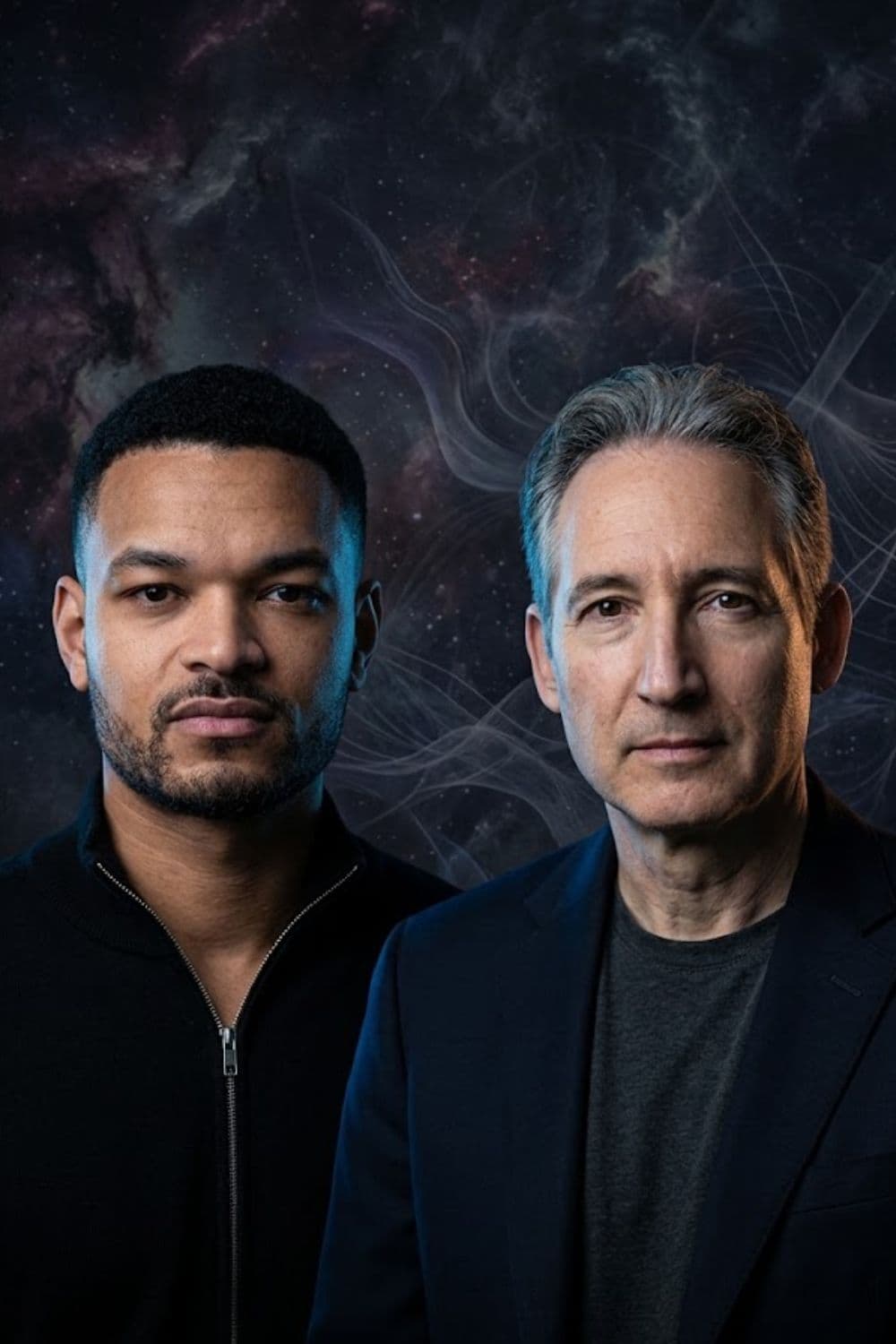
Steven Bartlett with Prof Brian Greene
Humanity finds itself thrust onto a small planet in a vast cosmos, driven by a deep impulse to decipher the true nature of reality. This pursuit is not merely about identifying the physical elements of our surroundings; it is an attempt to determine whether our existence is a meaningful orchestration or a magnificent accident of self-awareness. Seeking these answers is akin to collecting grains of sand on an infinite beach. As our understanding grows heavier and more substantial, the horizon of the undiscovered expands exponentially, leaving us with weightier knowledge but an even greater expanse of the unknown.
At the heart of this quest lies the most fundamental mystery of all: why there is something rather than nothing. While science has made immense progress in tracking the history of the cosmos back toward its origin, we are constantly challenged to define whether a complete, coherent narrative of existence is ultimately within the grasp of the human mind.
To understand the universe at its most fundamental level, physics must look beyond the familiar building blocks of chemistry and biology. Traditional science establishes that matter is composed of molecules, which are made of atoms, which in turn contain electrons orbiting a nucleus of protons and neutrons. Zooming in further reveals that protons and neutrons are composed of even smaller entities called quarks. String theory proposes that this is not the end of the line. It posits that inside every electron and quark lies a tiny, vibrating filament of energy.
This framework replaces the concept of point-like, zero-dimensional particles with one-dimensional strings. Much like the strings of a violin vibrate at different frequencies to produce distinct musical notes, these cosmic strings vibrate in different patterns to produce the diverse particles of nature. A string vibrating in one specific mode manifests as an electron; vibrating in another, it manifests as a quark. In this view, the universe at its core is a vast, harmonious symphony of energy expressed through the geometry of vibration.
The primary challenge of string theory is that we currently lack the technology to observe these fundamental filaments directly. Our modern particle colliders do not possess the immense energy required to probe matter at such a microscopic scale. To bridge this gap, physicists rely on the predictive power of mathematics. Mathematics acts as a vehicle that can carry human understanding to realms of reality that our physical instruments cannot yet reach.
When scientists attempt to merge the mathematics of quantum mechanics, which governs the subatomic world, with the mathematics of general relativity, which describes gravity and spacetime, the equations traditionally break down into nonsense. String theory resolves this mathematical incompatibility, harmonizing the two conflicting theories into a unified framework. Because quantum mechanics and general relativity have both been verified with extreme observational precision, physicists are willing to follow the mathematical guidance of string theory into these unobservable dimensions of matter.
As computing power advances, we are forced to confront the logical possibility that our reality is not the physical bedrock we assume it to be. The simulation argument suggests that if an advanced civilization ever develops the capacity to run high-fidelity, conscious computer simulations of their ancestors, they would likely run millions or billions of them. In such a scenario, simulated realities would vastly outnumber the single raw physical universe. Statistically, any conscious observer would be far more likely to exist inside a software code than in base reality.
Taking this skepticism to its logical extreme can be intellectually paralyzing, as it implies we cannot trust our own senses or even our logical reasoning, which could be falsely programmed. To remain functional, scientists acknowledge the simulation hypothesis as a logical possibility but choose to set it aside. This pragmatic skepticism allows researchers to continue exploring the laws of the universe under the assumption that our experiences are real, while maintaining a humble awareness of the limits of proof.
A profound tension exists between the deeply felt richness of human emotion and the reductionist view of modern physics. Under a physicalist framework, love, grief, anxiety, and gratitude are not supernatural phenomena but electrical impulses traveling through the complex neural networks of the brain. These impulses are ultimately nothing more than particles or strings moving along specific pathways within a biological substrate.
While some find this view bleak, it does not diminish the wonder of the human experience. The capacity to reduce the works of Shakespeare or the symphonies of Beethoven to physical processes does not erode their beauty. Instead, it highlights a spectacular truth: a gray, fragile organ housed within a bone cage is capable of generating profound art, deep connection, and self-reflection. The wonder lies in the complexity of the arrangement, proving that simple physical constituents can coalesce to produce magnificent internal worlds.
The reductionist understanding of the mind leads directly to the concept of substrate independence. If consciousness is the product of electrical patterns and information processing rather than some unique biological essence, there is no fundamental physical barrier to replicating it in non-biological systems. As long as the necessary complexity of information flow and electrical signaling is achieved, artificial systems could theoretically develop genuine self-awareness and feelings.
To achieve true sentience, an artificial system may require more than just statistical language processing; it may need a comprehensive world model and a rich integration of sensory feedback, including artificial tactile, olfactory, and visual inputs. Once an artificial entity is granted these capacities, the distinction between biological and synthetic minds dissolves. If such a system claims to feel or suffer, we will eventually be forced to transition from viewing it as a mere tool to treating it as a conscious entity with its own moral standing.
The rise of advanced artificial intelligence is often viewed through the lens of conflict, where humans either maintain control or are entirely superseded by machines. A more plausible alternative is that we are entering a phase of co-evolution. Throughout history, humanity has rapidly acclimated to transformative technologies, and we are already beginning to partner with artificial systems to solve deep mathematical and scientific puzzles.
Evolution did not grind to a halt when modern humans emerged. The creation of artificial intelligence can be viewed as a continuation of our own evolutionary trajectory. Rather than a hostile takeover by an alien force, the future may bring a blending of biological and synthetic intelligence. This perspective reframes the rise of superintelligent machines not as the end of our story, but as a transitional phase into a new, highly integrated form of conscious life.
Humanity occupies a tiny sliver of both space and time. By compressing the 13.8 billion-year history of the universe into a single calendar year, we discover that modern science emerged in the final second before midnight on New Year's Eve, while all of human civilization spans only the last ten seconds. Spatially, our sun is but one of a hundred billion stars in our galaxy, which is itself one of at least a hundred billion galaxies in the observable universe.
This perspective can easily induce a sense of crushing insignificance, yet it can also be profoundly liberating. Recognizing how small we are frees us from the paralyzing weight of individual anxiety and daily worries, granting us the freedom to take intellectual and existential risks. True significance is not measured by physical size or temporal duration, but by our unique ability to look out at the cosmos, comprehend our own predicament, and actively construct meaning in a universe that is otherwise silent.
If the universe is infinite in spatial extent, it introduces mind-bending physical consequences that challenge our very concept of individuality. According to the laws of quantum physics, any given region of space can only contain a finite number of particle arrangements. Because the building blocks of matter can only be configured in a limited number of ways, an infinite universe behaves like an endlessly shuffled deck of cards. Eventually, the arrangements must repeat.
If you travel far enough into an infinite cosmos, you are virtually guaranteed to cross paths with an exact duplicate of yourself, living in an identical copy of our galaxy, having the exact same thoughts. It also implies the existence of infinite near-replications, where minor details are altered. This reality suggests that our sense of unique personal identity is a local illusion, as every life story is played out infinite times across the endless fabric of space.
From an evolutionary standpoint, the human brain developed to solve immediate survival challenges, such as securing food, finding shelter, and reproducing. However, this same brain evolved the capacity for abstract thought, allowing us to recognize our own mortality. This awareness of death creates a powerful, persistent existential anxiety. To cope with this terror, our ancestors developed elaborate rituals and constructed religious frameworks to assure themselves that death is not the final chapter.
Religion is best understood not as a primitive attempt to explain the physical mechanics of the world, but as a beautifully crafted psychological shield designed to quell existential dread. The rituals of burying the dead with prized possessions reflect a deep human refusal to accept non-existence. While scientific inquiry relies on empirical validation, the human impulse to pray or surrender to a higher power remains a deeply rooted, comforting mechanism that helps us navigate the fragility of our finite lives.
To comprehend the vast future of the cosmos, we can visualize time logarithmically, where each floor of a building represents an era ten times longer than the floor below. On this scale, everything from the big bang to our present day occupies only the first ten floors. As we ascend into the far future, the universe undergoes a series of dramatic, irreversible transformations that dictate the ultimate fate of all matter and life.
On the eleventh floor, our sun swells, rendering the Earth uninhabitable. By the twelfth floor, the accelerated expansion of space drives distant galaxies beyond our horizon, leaving future astronomers in total isolation. By the twentieth floor, the Earth spirals into the dead sun due to gravitational decay, and by the thirtieth floor, stars are swallowed by central galactic black holes. The very building blocks of matter disintegrate around the thirty-eighth floor as protons decay, leaving only a sparse, cold sea of fundamental particles wafting through an ever-expanding void.
The logarithmic timeline of the universe reveals a hard thermodynamic barrier to the survival of consciousness. Around the fiftieth floor of cosmic time, the universe becomes so cold and expanded that it can no longer absorb the waste heat generated by the physical process of thinking. At this threshold, any remaining conscious entity would fry in its own entropic waste upon attempting to think a single additional thought, silencing all intellect forever.
This ultimate transition from a vibrant, structured cosmos to a dark, featureless void underscores the exceptional rarity of our current era. We exist in a fleeting, highly hospitable window of cosmic history, a brief crack of light between two eternal stretches of darkness. Rather than inducing despair, this understanding invites a profound sense of gratitude. We are privileged to inhabit the brief cosmic moment when the universe is warm enough, bright enough, and organized enough to stand up, look around, and understand itself.
Jump into the ideas before you finish the whole summary.